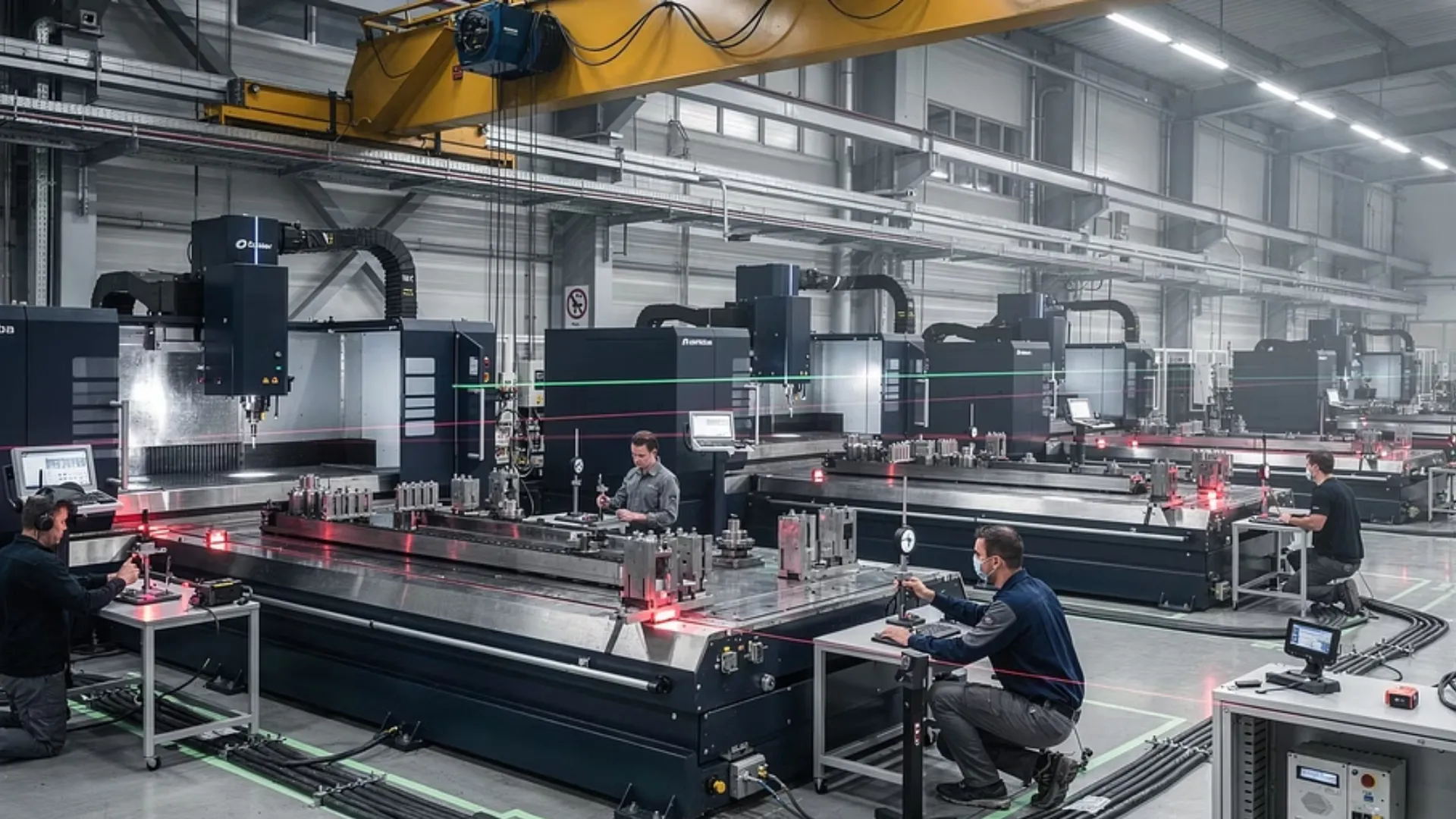
Industrial Assembly: Processes, Standards and Outsourcing Benefits
The German machinery sector generated revenues of 254 billion euros in 2024. At the same time, the Federal Employment Agency reports over 387,000 unfilled skilled positions — a talent shortage rate of 86%, well above the global average of 74%. Against this backdrop, industrial assembly as an outsourced service is gaining strategic importance. Those who delegate mechanical, electrical and pneumatic assembly to specialised partners secure capacity and quality without long-term staffing commitments.
What is industrial assembly
Industrial assembly refers to the professional integration of individual parts and sub-assemblies into fully functional machines, installations and production lines. The process spans multiple disciplines:
- Mechanical assembly — Pre-assembly, intermediate assembly and final assembly of sub-assemblies. Bolting, joining, alignment and adjustment techniques.
- Electrical installation — Wiring, control panel construction, sensor and actuator integration in accordance with DIN EN 60204-1
- Pneumatics — Compressed air supply, valves, cylinders and pneumatic control circuits
- Hydraulics — High-pressure systems, hydraulic cylinders, pump units and pipework
- [Commissioning](/en/noticias/proyecto-llave-en-mano-industrial) — Functional testing, parameter optimisation, FAT and SAT
Industrial assembly is the final and decisive step before machine handover to the customer. It is here that engineering, manufacturing and automation must converge into a reliably functioning unit.
Assembly processes in industrial applications
Industrial assembly follows a structured sequence from component manufacture through to a production-ready machine:
Pre-assembly (sub-assemblies)
Individual functional units are assembled separately: drive units, linear guides, tool changers. This parallelisation significantly reduces overall lead time.
Final assembly
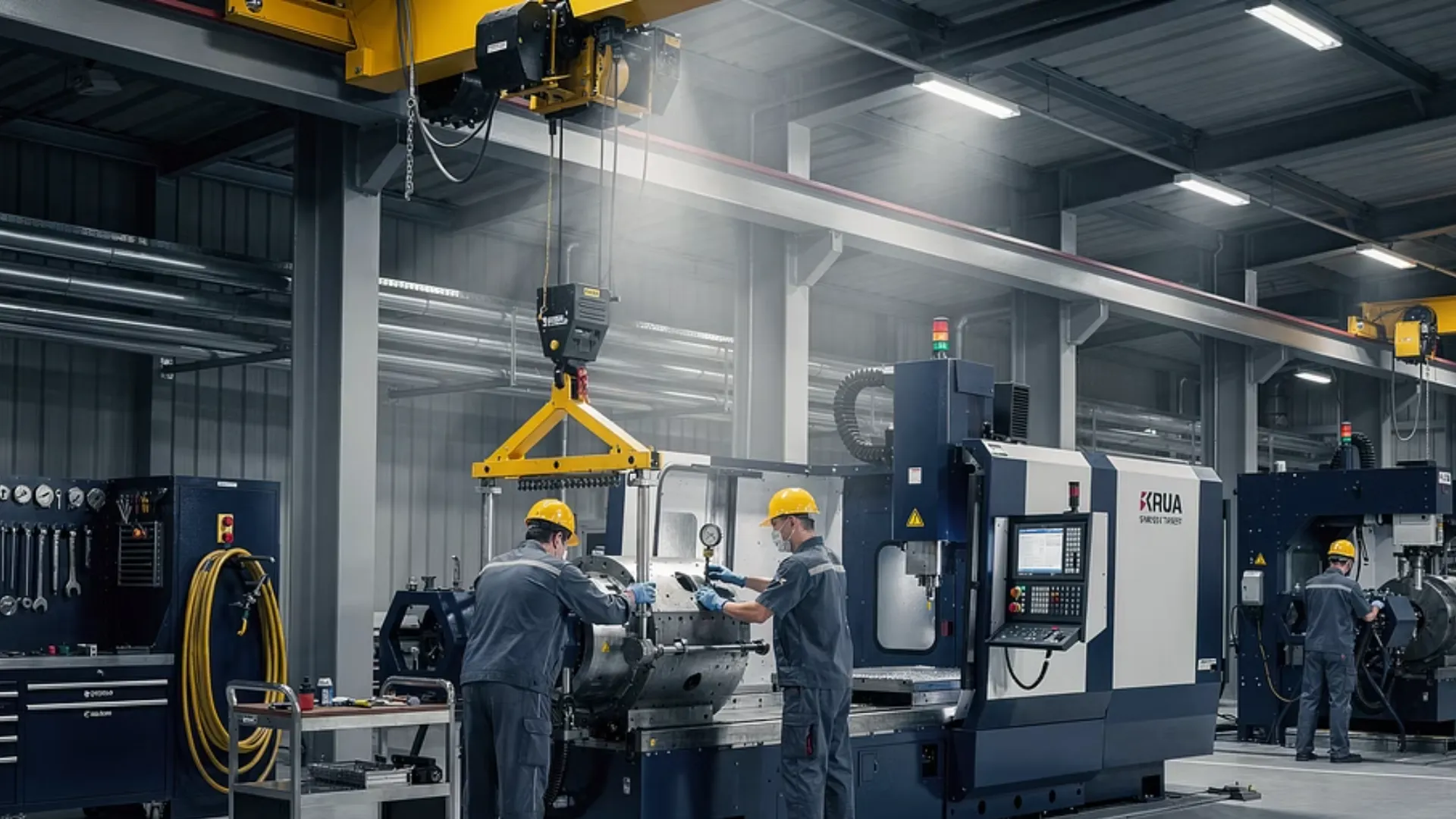
Pre-assembled sub-assemblies are brought together on the machine bed. Precise alignment, levelling and bolting ensure the geometric accuracy of the equipment.
Electrical assembly
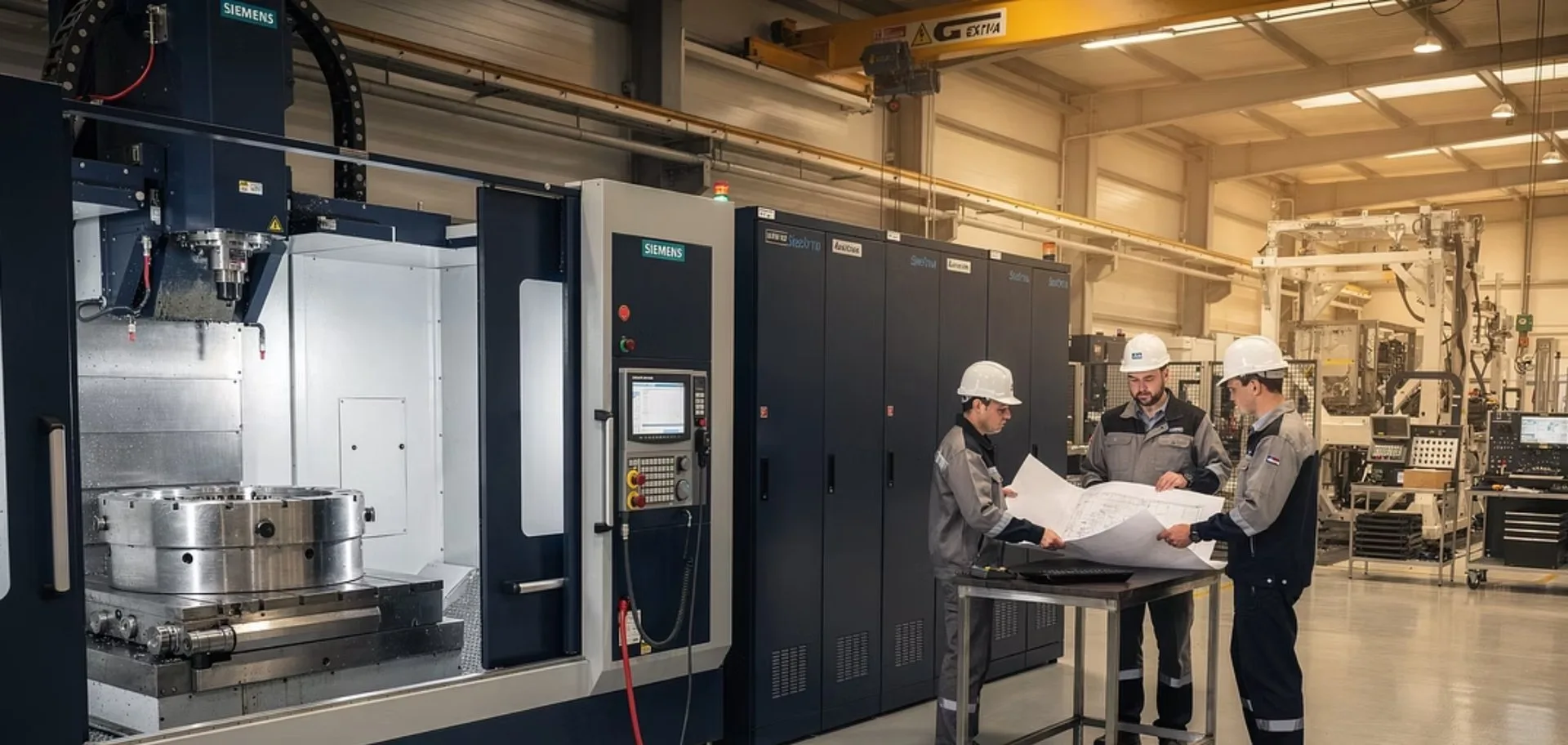
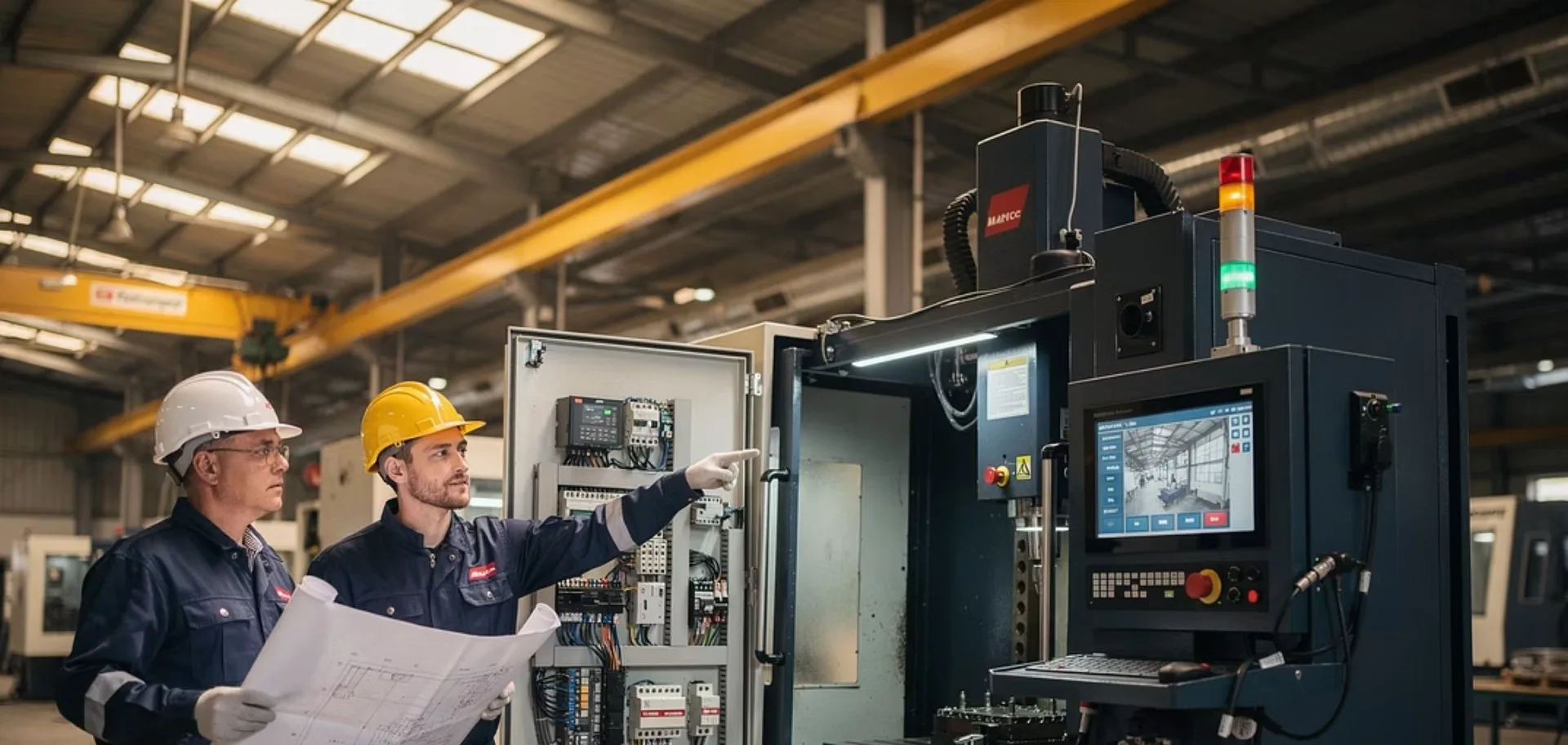
In accordance with DIN EN 60204-1, control panels are installed, cables are routed and sensors and actuators are connected. Electrical integration encompasses PLC wiring, HMI connection and fieldbus systems (Profinet, EtherCAT).
Commissioning and acceptance
The concluding phase comprises:
- 1.FAT (Factory Acceptance Test) — Functional verification at the integrator's premises
- 2.Transport and installation — Specialist packaging, logistics and installation at the customer's site
- 3.SAT (Site Acceptance Test) — Acceptance under real production conditions
- 4.Training — Instruction for operators and maintenance teams
Which standards apply to industrial assembly
The regulatory framework for industrial assembly is extensive:
| Standard | Subject | Significance |
|---|---|---|
| DIN EN ISO 9001 | Quality management system | Foundation for every assembly service provider |
| DIN EN 60204-1 | Electrical equipment of machines | Control panels, wiring, EMC |
| DIN EN ISO 13849-1 | Functional safety (PLr) | Safety-related parts of control systems |
| DIN EN ISO 12100 | Safety of machinery — Risk assessment | Risk assessment during design and assembly |
| (EU) 2023/1230 | New Machinery Regulation (from Jan. 2027) | Replaces Directive 2006/42/EC. New requirements for cybersecurity and AI. |
The new EU Machinery Regulation (EU) 2023/1230, published on 29 June 2023, becomes mandatory from 20 January 2027. It introduces requirements for cybersecurity, artificial intelligence and digital components — a key consideration for everyone involved in industrial assembly.
Looking for a partner for industrial assembly and special-purpose machinery?
Request a quotation — our engineering team will analyse your requirements.
Why outsource industrial assembly
Outsourcing industrial assembly delivers measurable benefits, particularly against the backdrop of acute skilled-labour shortages:
Benefits of outsourcing:
- Capacity flexibility — Scale assembly capacity to match demand without retaining idle internal staff during low-volume periods
- Access to specialist expertise — Qualified fitters, electricians, PLC programmers and robotics integrators without in-house recruitment
- Cost transparency — Fixed-price agreements for predictable project costs
- Focus on core competencies — Design, sales and customer support remain in-house
- Regulatory compliance — The assembly partner ensures conformity with DIN EN 60204-1, ISO 13849 and CE marking
- Single source — One point of contact for mechanical, electrical, pneumatic and commissioning activities
The trend towards modular assembly also enables mid-sized companies to automate incrementally — station by station — without a massive upfront investment.
Industrial assembly at MECVIL: turnkey integration
Industrial assembly is not an isolated discipline — it demands seamless coordination of engineering, CNC machining, electrical engineering and automation. That is why clients seek partners who cover the entire value chain.
MECVIL has an assembly capacity of 5,000 hours per month for mechanical and electrical assembly. In our 10,500 m² production facility in Sallent, near Barcelona, we integrate:
- Mechanical assembly — Pre-assembly, final assembly, precision alignment
- Electrical installation — Control panel construction, wiring, PLC connection (Siemens, Omron, Panasonic, Mitsubishi)
- Robotics — Integration of industrial robots (ABB, DENSO) and cobots (Universal Robots)
- Machine vision — Cognex systems with Deep Learning for automated quality control
- Pick & Place — Handling systems with suction cups, grippers and magnetic handling
What sets MECVIL apart from pure assembly service providers is vertical integration. Under one roof, we combine engineering (3,000 h/month), CNC machining (5,000 h/month with travel up to 20 metres), assembly, electrical engineering (1,500 h/month) and industrialisation.
Over 110 professionals, including 30+ engineers, deliver turnkey projects — from concept through manufacture to commissioning at the customer's site, including FAT, SAT and operator training.
Planning an industrial assembly project? Contact MECVIL for a no-obligation quotation. ISO 9001 certified, 50 years of manufacturing expertise and end-to-end capacity from engineering to commissioning.