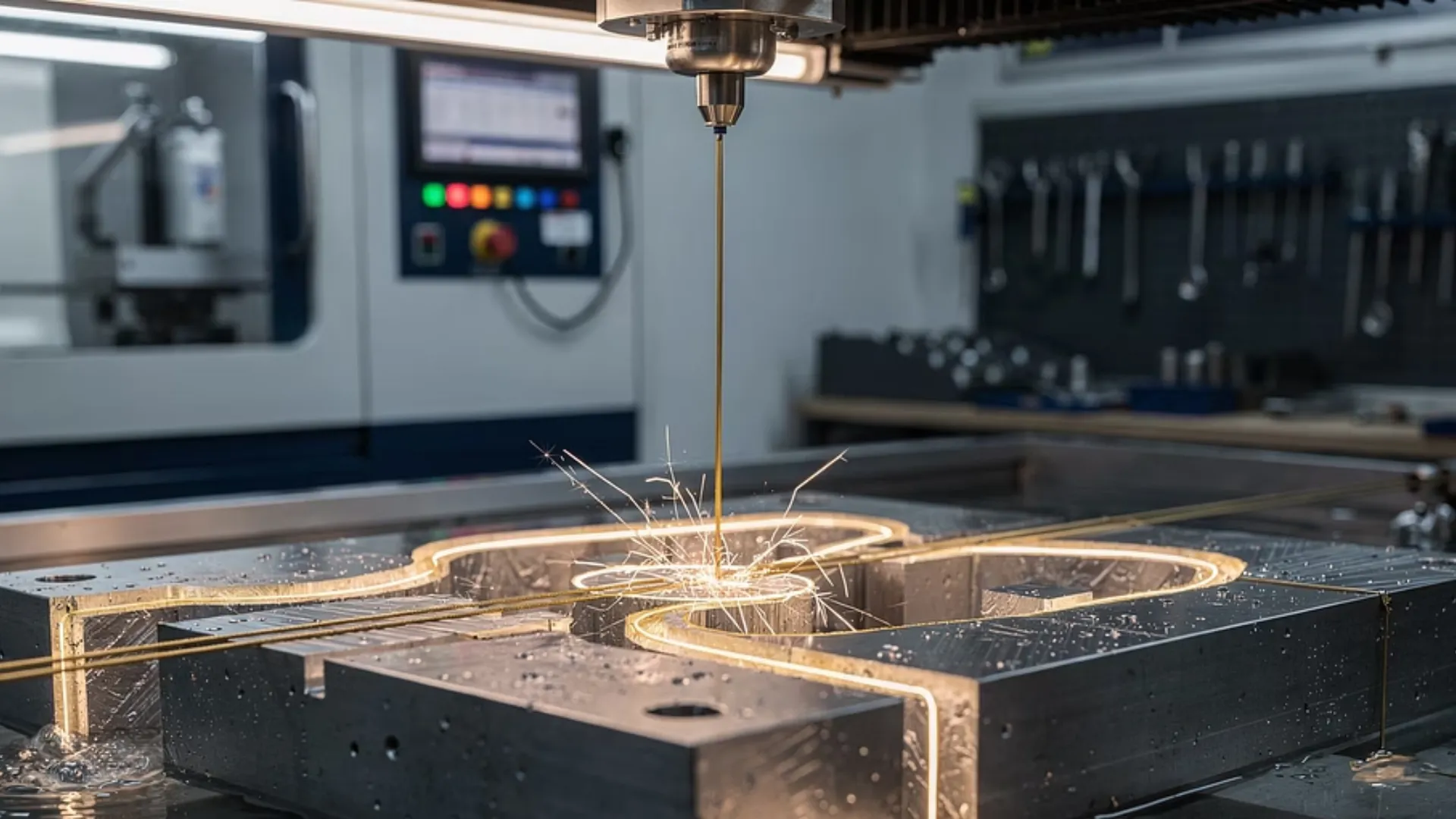
Wire EDM: Tolerances, Materials and Industrial Applications
Wire electrical discharge machining (Wire EDM) is a non-conventional machining process that can cut any electrically conductive material, regardless of its hardness. Where CNC milling reaches its limits — hardened steels above 55 HRC, sharp internal corners, thin walls — wire EDM operates with tolerances of +/-0.005 mm and surface roughness Ra below 0.2 um. For manufacturers of moulds, dies, precision tooling or aerospace components, this technology is indispensable.
How wire EDM works
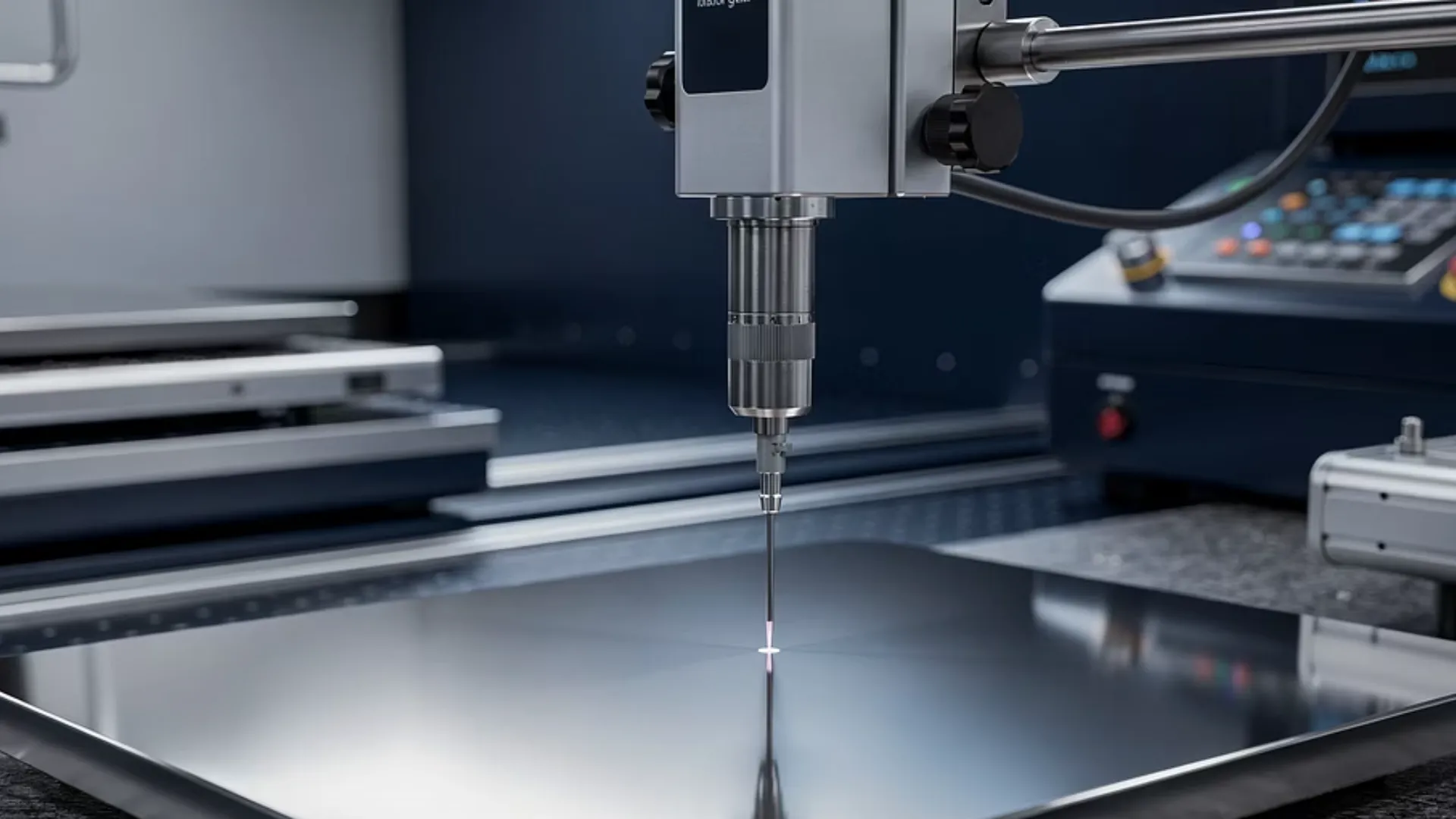
Wire EDM uses a thin metallic wire (brass or copper, typical diameter 0.1-0.3 mm) as an electrode. The wire, fed continuously, generates controlled electrical discharges between itself and the workpiece, which is submerged in a dielectric fluid (deionised water or oil). Each discharge vaporises a microscopic quantity of material, with no mechanical contact whatsoever.
Key characteristics of the process:
- No mechanical stress on the workpiece — perfect dimensional stability even on thin walls
- No burrs — parts require no post-machining deburring
- Extremely sharp internal corners — radii of a few hundredths of a millimetre, impossible with a milling cutter (which always leaves a radius equal to the tool diameter)
- Negligible tool wear — wire consumption is constant regardless of material hardness
Tolerances and surface roughness in wire EDM
Wire EDM achieves precision levels comparable to grinding:
| Parameter | Roughing | Standard finish | Fine finish |
|---|---|---|---|
| Tolerance | +/-0.02 mm | +/-0.01 mm | +/-0.005 mm |
| Roughness Ra | 1.6-3.2 um | 0.4-0.8 um | 0.2 um |
| Passes | 1 | 2-3 | 4-6 |
Roughness parameters follow the ISO 4287 standard, which defines Ra, Rz and Rt as standard references for machined surface specification. For applications requiring mirror finishes (Ra 0.1 um), oil-based dielectrics and multiple finishing passes are employed.
Which materials can be machined with wire EDM
The only requirement is electrical conductivity. The most common materials include:
- Hardened steels (>55 HRC) — mould steels, high-speed steels, tool steels
- Stainless steel — components for the food, pharmaceutical and chemical sectors
- Titanium and titanium alloys — aerospace, medical, defence
- Nickel-based superalloys (Inconel) — turbines, high-temperature components
- Tungsten carbide — cutting tools, extrusion dies
- Aluminium — lightweight components for electronics and aerospace
CNC milling remains faster (15-20 times) for soft materials and simple geometries. Wire EDM becomes the only viable option when hardness exceeds 50-55 HRC or when internal corners without radii are required.
Do you need wire EDM machining for your project?
Request a quotation — our technical team will analyse your drawings and specifications.
Industrial applications of wire EDM
Wire EDM serves sectors with the most demanding technical requirements:
- Moulds and dies — injection moulds, die-casting dies, progressive dies with complex cavities and sharp internal corners
- Aerospace — turbine components, control systems, structural parts in titanium and superalloys
- Medical — surgical instruments, implant components in biocompatible materials
- Automotive — engine parts, precision gears, transmission components
- Tooling — punches, precision gauges, hardened steel blades
- Electronics — micro-connectors, precision contacts
Wire EDM vs CNC milling: when to choose which
The choice between wire EDM and 5-axis CNC milling depends on three main factors:
| Criterion | Wire EDM | CNC milling |
|---|---|---|
| Material hardness | Any (even >65 HRC) | Optimal up to 45-50 HRC |
| Internal corners | Radii of 0.05 mm | Minimum radius = cutter radius |
| Speed | 15-20x slower | High for large volumes |
| Stresses | Zero (no contact) | Cutting forces present |
| Roughness | Ra 0.2 um (fine finish) | Ra 0.4-1.6 um (tool-dependent) |
| Cost per part | High for simple geometries | Competitive for series |
The optimal strategy combines both technologies: CNC milling for roughing and accessible geometries, wire EDM for finishing on hard materials and complex profiles. A partner that integrates both processes under one roof eliminates transfer times and interface issues.
Wire EDM integrated into CNC machining
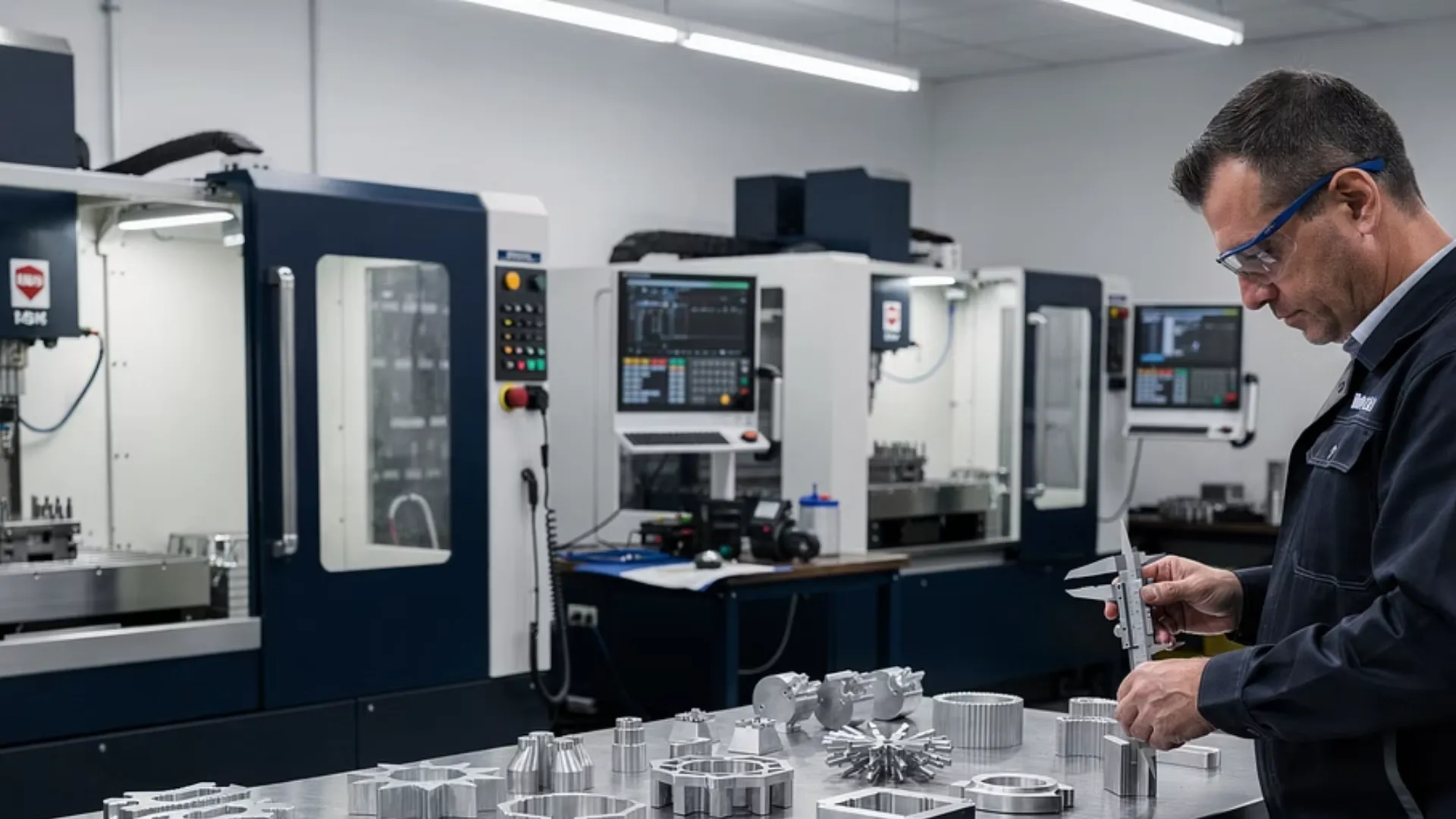
MECVIL offers wire EDM as an integral part of its CNC machining department, with a capacity of 5,000 hours/month. We also operate simultaneous 5-axis machining centres, turning, grinding and fixed-bed milling machines with travel up to 20 metres.
The advantage for the client is the complete supply chain within a single 10,500 m2 facility in Sallent, near Barcelona:
- [Engineering](/en/servicios/ingenieria) — 3,000 h/month of mechanical and electrical design
- CNC machining — milling, turning, grinding, wire EDM
- [Assembly](/en/servicios/montaje) — 5,000 h/month of electromechanical assembly
- [Turnkey projects](/en/servicios/proyectos-globales) — from design through to commissioning
Over 110 professionals, including 30+ engineers, ensure the precision and traceability demanded by the aerospace, automotive and medical sectors. ISO 9001 certified.
Have a project requiring wire EDM? Contact MECVIL for a no-obligation quotation. 50 years of experience in precision machining.