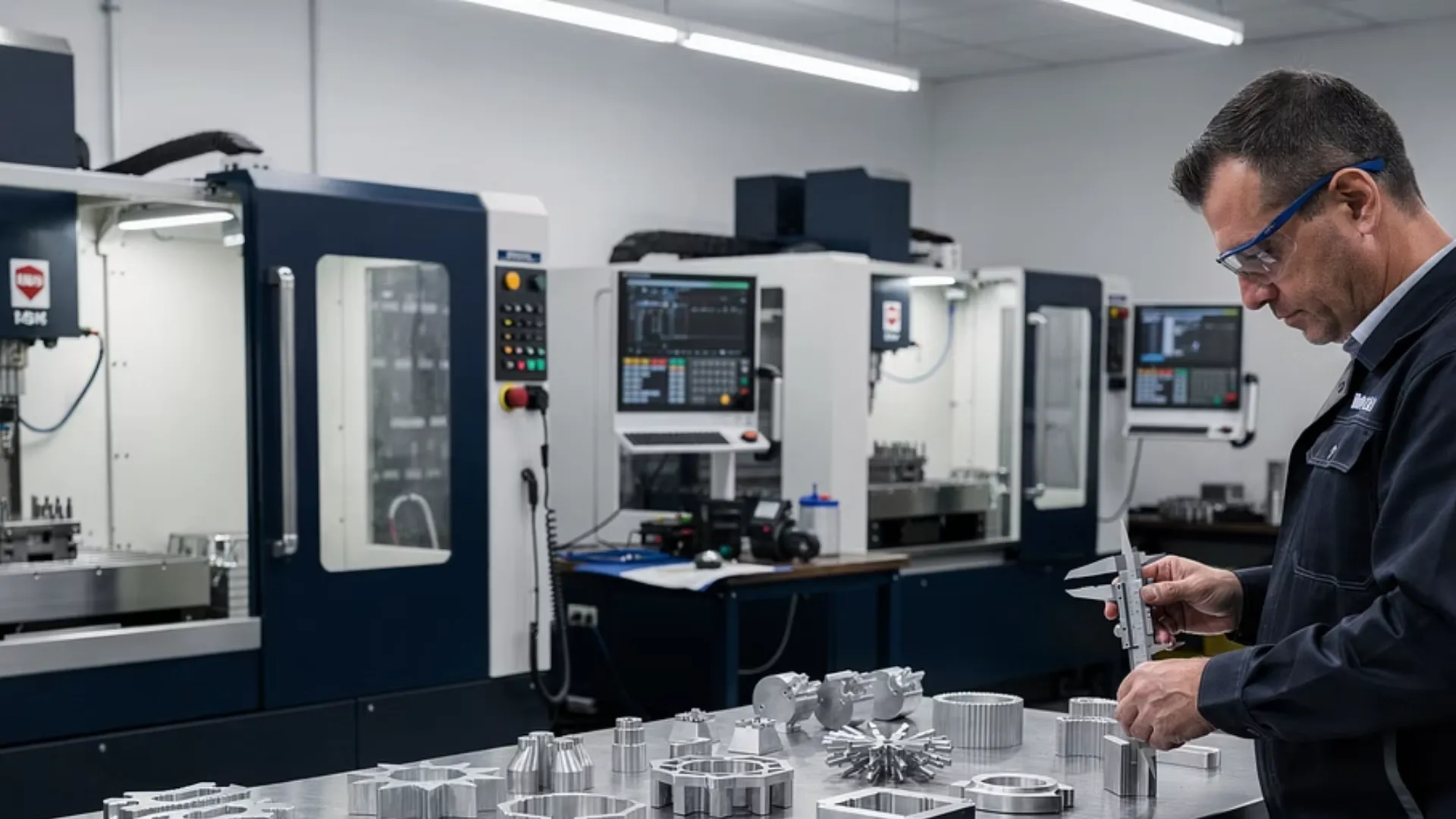
Industrial Prototyping and Short Runs: CNC Machining to Drawing
What is industrial CNC prototyping
Industrial CNC prototyping is the process of manufacturing functional parts — not mock-ups or decorative 3D prints — directly from technical drawings, using the same materials and tolerances as the production part. Unlike rapid prototyping, where the aim is to validate shapes, industrial prototyping seeks to verify mechanical behaviour, dimensional fit and manufacturing feasibility before committing to full production.
CNC machining delivers prototypes in steel, stainless steel, aluminium (6061, 7075), titanium, grey cast iron and engineering plastics, with tolerances from 0.01 mm and surface finishes of Ra 0.8 µm. The prototyped part is identical to the final part: same mechanical properties, same strength, same geometry. This makes CNC machining the reference technology for functional validation in sectors such as automotive, aerospace, railway and hydraulics.
CNC vs casting for prototypes
When an engineering manager needs a metal prototype, the usual question is: machine from solid or make a mould and cast? The answer depends on volume, lead time and geometric complexity. This comparison summarises the key differences:
| Criterion | CNC machining | Casting |
|---|---|---|
| Lead time | 1–3 weeks (no tooling) | 8–16 weeks (mould + casting + machining) |
| Initial investment | Low (CAM programming only) | High (mould/pattern design and manufacture) |
| Design flexibility | Maximum (changes in CNC programme) | Limited (each change requires mould modification) |
| Dimensional accuracy | 0.01–0.05 mm directly on the machine | 0.2–0.5 mm (post-machining required) |
| Available materials | Steel, stainless, aluminium, titanium, engineering plastics | Mainly grey/ductile iron, aluminium, bronze |
| Cost per part (1–50 pcs) | Competitive | Very high (mould amortisation) |
| Cost per part (500+ pcs) | Increasing | Decreasing (mould is amortised) |
The conclusion is straightforward: for volumes below 500 parts, CNC machining is faster, more flexible and more economical. Casting only becomes competitive when volume justifies the tooling investment — something that rarely applies during validation phases or niche industrial production.
Short runs: from 1 to 500 parts
Short runs occupy a territory where mass-production techniques are not viable and manual fabrication cannot guarantee repeatability. CNC machining solves both problems: every part is manufactured with the same toolpath, the same cutting parameters and the same dimensional control, whether the batch is 1 or 500 units.
In practice, a short-run CNC programme includes:
- Functional prototypes (1–5 parts): design validation, assembly trials and mechanical testing. The engineering department reviews manufacturability before programming begins.
- Pre-production runs (10–50 parts): qualification batches for the end customer, process verification and adjustments before definitive production.
- Limited production series (50–500 parts): components for special machinery, spare parts for discontinued equipment or replacement parts with specific geometry.
The advantage of CNC over other processes is traceability: every part is documented with its programme, parameters and inspection results. This is especially relevant in regulated sectors — railway, pharmaceutical, aerospace — where technical documentation is as important as the part itself.
When to choose CNC machining for prototypes
Not every prototype requires CNC machining. Polymer 3D printing is sufficient for form mock-ups; bent sheet metal is adequate for enclosures without dimensional demands. However, there are scenarios where CNC is the only technically valid option:
- Parts subjected to mechanical loads: the prototype must withstand the same forces as the production part. Only machined metal guarantees the required mechanical properties.
- Tight tolerances: when the fit between components demands tolerances of 0.02 mm or below, precision machining is the answer.
- Specific materials: if the final part will be 7075 aluminium, titanium or stainless steel, the prototype must be made from the same material to obtain representative test results.
- Process validation: a CNC prototype verifies that the part can be series-produced with the same equipment, detecting tool-access problems, vibrations or deformations before committing to production.
- Short deadlines: compared with 8–16 weeks for a casting mould, a CNC prototype can be ready in days. When time-to-market is critical, CNC accelerates the development cycle.
Need functional metal prototypes or a short-run batch to drawing?
At MECVIL we manufacture from 1 part with the same rigour as a full series. Send us your drawings and receive a technical proposal with lead time and cost.
Prototypes and short runs at MECVIL
At MECVIL, industrial prototyping and short runs are an essential part of our daily work. Our capability combines production resources, technical expertise and an integrated working model:
- High-capacity CNC machinery: simultaneous 5-axis machining centres, CNC milling and turning, grinding and wire EDM. Our SORALUCE FP20, with 20 metres of travel, machines large-dimension parts in a single set-up.
- Engineering department: 3,000 hours/month of design capacity with 3D CAD, CAM programming and FEA simulation. We review the manufacturability of every drawing and propose optimisations before machining begins.
- Materials: we work with steel, stainless steel, aluminium (6061, 7075 and other alloys), titanium, grey cast iron and engineering plastics.
- Production capacity: 5,000 hours/month of CNC machining, with flexibility to interleave short runs without penalising lead times.
- Documented quality: ISO 9001 system, coordinate measuring and inspection reports for every batch. Traceability extends from raw material to delivered part.
- Turnkey capability: if a prototype evolves into series production, MECVIL can manage industrialisation, assembly and delivery as a turnkey project from our 10,500 m² facility in Sallent (Barcelona).
Manufacturing prototypes and short runs demands the same technical discipline as a large series: validated programme, dimensional control and complete documentation. The difference is that at MECVIL we do it from 1 part, with the agility your project needs.
Have an industrial prototyping or short-run project?
Over 110 professionals and 50 years of experience stand behind every part that leaves our machines. Contact MECVIL and discover how we can accelerate your development.