Lean manufacturing in industrial production: a practical guide from the shop floor
What is lean manufacturing?
Lean manufacturing is a production management methodology aimed at eliminating everything that does not add value to the final product. Its origins trace back to the Toyota Production System (TPS), developed by Taiichi Ohno from 1950 onwards at Toyota's factories in Japan. The term "lean" was coined by MIT researchers in 1990 to describe this production system that achieved more with less.
The premise is straightforward: identify the activities that truly transform the product and systematically eliminate those that do not. In a CNC machining workshop, for example, the time a milling machine spends cutting metal is value; the time it sits idle waiting for a programme, a tool or a raw workpiece is waste.
Contrary to what most consultancies and business schools publish, lean manufacturing is not just theory applicable to automotive assembly lines. It applies with equal effectiveness in special machinery workshops, in make-to-order production and in high-variety, low-volume environments. At MECVIL, we have been manufacturing industrial machinery for over 50 years, and lean principles are embedded in the way we work.
The 8 wastes in an industrial manufacturing workshop
The core concept of lean is the elimination of _muda_ (waste). Taiichi Ohno identified 7 original types, to which an eighth was subsequently added. In the context of a special machinery manufacturing workshop, they manifest as follows:
- 1.Overproduction: manufacturing parts before they are needed, generating intermediate stock that occupies space and ties up capital
- 2.Waiting: idle time whilst the CNC machine waits for a programme, a fixture or a quality approval
- 3.Unnecessary transport: movement of parts between buildings or workstations that adds no value to the product
- 4.Over-processing: applying finishes or tolerances more demanding than what the customer actually requires
- 5.Excess inventory: accumulation of raw materials, work-in-progress or finished goods without an associated order
- 6.Unnecessary motion: operators searching for tools, drawings or fixtures in a disorganised workshop
- 7.Defects: rejected parts that must be remade, with the consequent waste of material, machine time and capacity
- 8.Underutilised talent: failing to incorporate the knowledge of the CNC operator — who knows the machine better than anyone — into process improvement
In a make-to-order environment such as MECVIL, where every special machinery project is different, the most critical wastes tend to be waiting and over-processing. The key lies in designing processes that minimise this downtime without sacrificing the flexibility that bespoke production demands.
Lean tools applied to CNC machining
Lean manufacturing offers a proven set of tools. The key is not to apply them all at once, but to identify which ones generate the greatest impact on your specific process.
SMED: reducing changeover time
SMED (_Single-Minute Exchange of Die_) is the methodology for reducing machine setup times to under 10 minutes. Developed by Shigeo Shingo, it has demonstrated average reductions of 94% in changeover times across documented implementations.
In CNC machining, a changeover involves replacing fixtures, loading programmes, positioning clamps and verifying the first part. At MECVIL, we apply SMED in concrete ways: our UTIL GRAPADO project is specifically designed with an SMED system, enabling manual product changeover compatible with multiple part references. Similarly, the FLEXIBLE TAPPING STATION uses a four-station rotary table to minimise downtime between batches of stamped parts.
5S: the foundation of productive order
The 5S methodology (Sort, Set in order, Shine, Standardise, Sustain) is the starting point for any lean implementation. In a workshop spanning over 10,500 m² such as MECVIL's facilities, with four specialised buildings (machining, assembly, welding and warehousing), workspace organisation is not a luxury — it is an operational necessity.
A workshop with properly implemented 5S dramatically reduces the time operators spend searching for tools, drawings or fixtures. Every item has an assigned location; every workstation is ready to produce.
TPM: total productive maintenance
Total productive maintenance (TPM) seeks to maximise equipment availability by involving the operators themselves in the basic maintenance of their machines. MECVIL was founded in 1976 precisely as a machinery maintenance company for the textile industry. Maintenance is in our DNA, and today we offer after-sales support and maintenance as an integral part of our turnkey projects.
Looking to optimise the efficiency of your production line?
At MECVIL, we design and manufacture industrial machinery with built-in lean principles. Consult our technical team to evaluate your case.
Poka-yoke and machine vision: quality built into the process
The concept of _poka-yoke_ (error-proofing) proposes designing the manufacturing process so that defects are either impossible or detected immediately, before progressing further down the production chain. This is more effective and economical than end-of-line inspection.
At MECVIL, we have integrated poka-yoke systems based on machine vision and automation in numerous real-world projects:
- AOI (Automated Optical Inspection): a machine vision system for automatic inspection that detects defects inline, without human intervention
- Electronic verification by vision: equipment adaptable to any product type that verifies electronic components on PCB assemblies, eliminating assembly errors
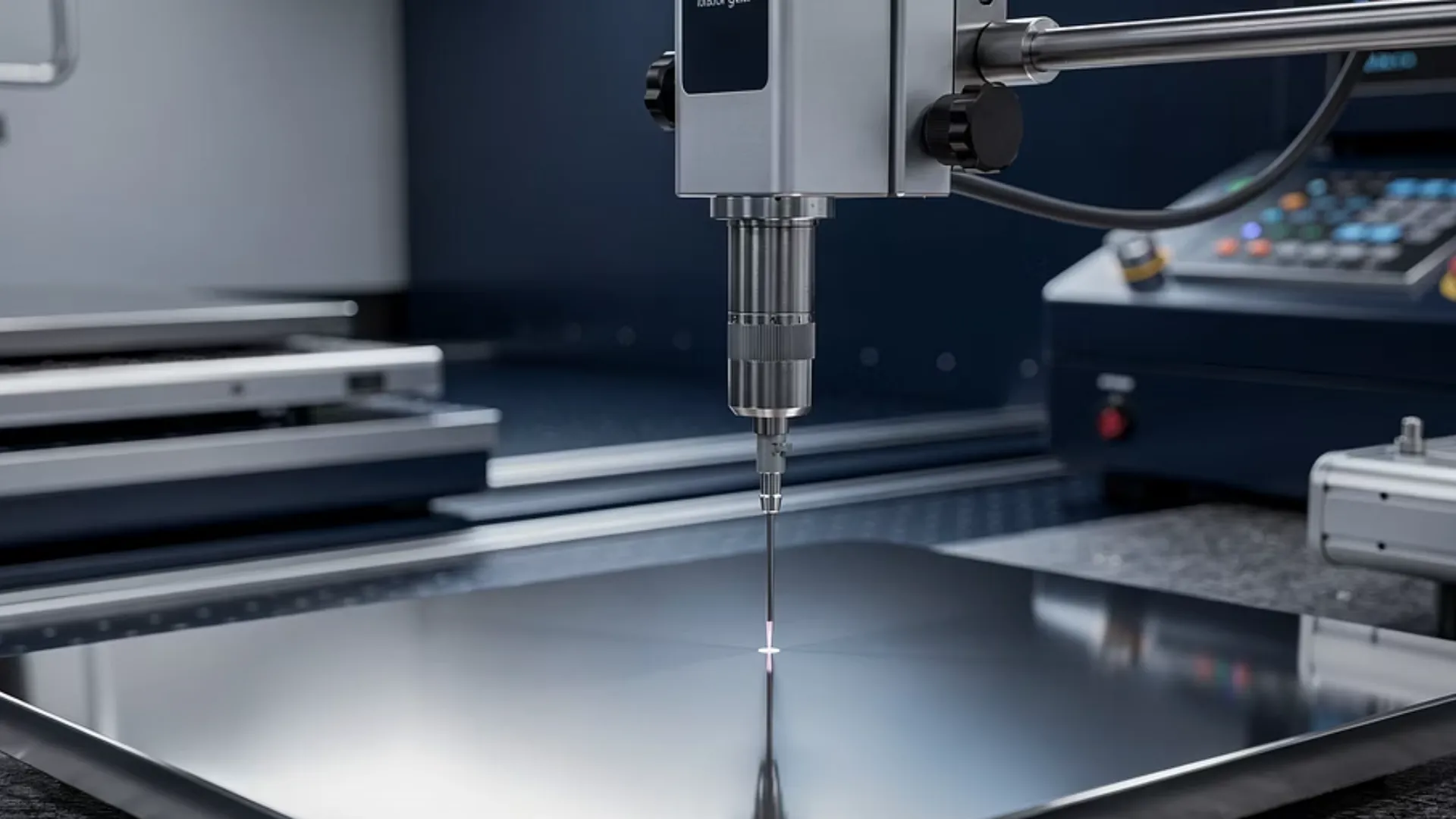
- Laser marking with verification: machines that integrate assembly, laser marking and machine vision verification in a single workflow, for electronic controllers
- Presence and insertion sensors: fixtures with sensors that verify both the presence of the workpiece and the correct insertion of components (clips, silentblocks, brackets)
These systems are not theoretical — they are machines we have designed, manufactured and commissioned in real production plants. Machine vision as poka-yoke is one of the most cost-effective lean applications in modern industrial manufacturing.
Can lean be applied in make-to-order production?
This is the question that most articles on lean manufacturing fail to answer. The classic literature assumes repetitive series production (the Toyota model). But what happens when every project is different, as in the manufacture of bespoke special machinery?
The answer is yes, with nuances. In make-to-order production (_Engineer-to-Order_ or _Make-to-Order_), lean principles are applied differently:
- Value is defined by each project: there is no standard product. Value Stream Mapping (VSM) is applied to the overall project flow (engineering → procurement → machining → assembly → commissioning), not to a repetitive part.
- Flexibility is a value, not a waste: in make-to-order production, the ability to adapt to design changes during the project is a competitive advantage. Lean does not mean rigidity; it means eliminating what does not add value.
- SMED is applied between projects: rather than switching between part references on the same machine, the transition between a completed project and the next one is optimised.
- Information flow is more critical than material flow: in special machinery, bottlenecks tend to occur in drawing approvals, specification confirmations or waiting for purchased components. Lean targets these information wastes.
At MECVIL, we manage 360° integrated projects spanning from design engineering through to commissioning. Applying lean in this context means optimising coordination between departments, reducing waiting times between phases and ensuring that every activity delivers real value to the project's final outcome.
OEE: measuring the real efficiency of your plant
You cannot improve what you do not measure. OEE (_Overall Equipment Effectiveness_) is the standard indicator in lean manufacturing for evaluating the real efficiency of a piece of production equipment. It is calculated by multiplying three factors:
OEE = Availability × Performance × Quality
| Level | OEE | Meaning |
|---|---|---|
| Typical | 55–65% | Most machining workshops without lean |
| Good | 70–80% | Workshops with active continuous improvement |
| World-class | 80–85% | Only 6% of manufacturers achieve this |
For a CNC machining workshop, the typical OEE sits between 55% and 65%. This means that, on average, more than a third of the potential productive time is lost to stoppages, slowdowns or defects. The benchmark of excellence for the industrial machining sector sits at 80–85% — an ambitious target, but achievable through the systematic application of SMED, TPM and 5S.
Measuring the OEE of each machining centre allows you to identify exactly where losses occur: is it a problem of availability (breakdowns, lengthy changeovers)? Of performance (conservative cutting speeds)? Of quality (rejected parts)?
Lean and Industry 4.0: a natural evolution
Lean manufacturing and industrial digitalisation are not contradictory approaches — they are complementary. Industry 4.0 technologies enhance classic lean tools:
- IoT on CNC machines: sensors that monitor OEE in real time, eliminating the need for manual logging (which is, in itself, a waste)
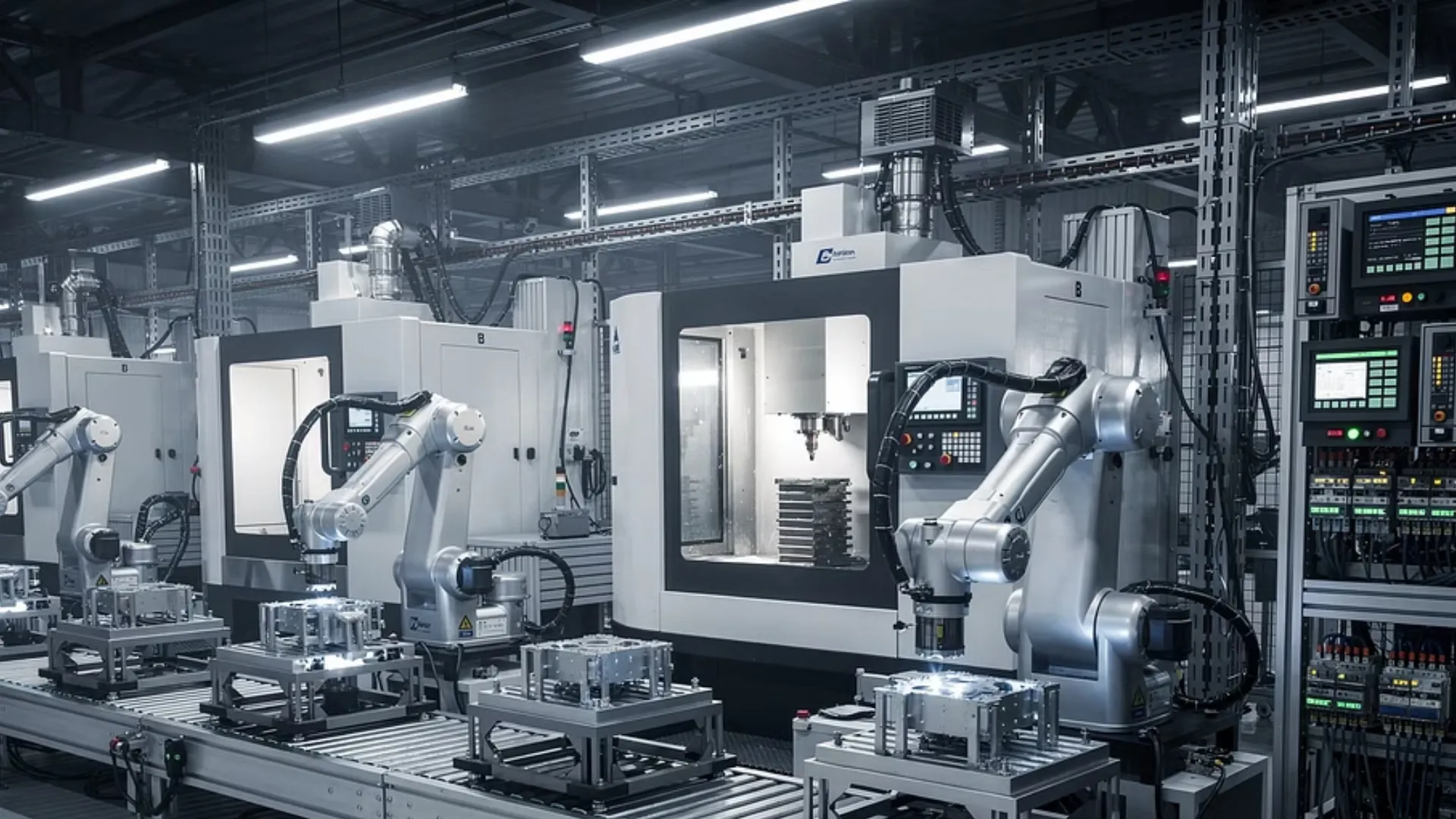
- FMS (Flexible Manufacturing Systems): at MECVIL, we have designed and manufactured multiple FMS lines with 4–5 robots, machine vision and automatic bonding. These lines integrate lean principles (continuous flow, in-process verification, rapid changeover) with advanced automation
- Robotics and cobots: robots eliminate motion waste and defects in repetitive tasks, whilst cobots (_collaborative robots_) work alongside operators, combining human flexibility with robotic precision
- Servomotors with energy recovery: our automated stations incorporate servomotors that recover braking energy, eliminating even energy waste
The combination of lean and technology enables manufacturers such as MECVIL to offer both the flexibility of a special machinery workshop and the efficiency of an automated production line.
Getting started: first steps towards lean in your workshop
If you manage a machining workshop or an industrial manufacturing plant and want to begin the transition towards lean manufacturing, these are the most effective steps to start with:
- 1.Measure your current OEE on critical equipment — without baseline data, you cannot evaluate progress
- 2.Implement 5S in a pilot area — choose one work centre, apply the 5S methodology and measure the impact on setup times
- 3.Apply SMED to your most frequent changeover — record a changeover on video, identify internal operations (machine stopped) and convert them to external ones (machine running)
- 4.Incorporate the operator's voice — the best improvement ideas come from the person who works with the machine every day
- 5.Eliminate one waste each week — continuous improvement (_kaizen_) is based on small accumulated improvements, not revolutions
The transition to lean manufacturing does not require a massive investment. It requires discipline, measurement and the willingness to question how things are done.
Need machinery designed with built-in lean principles?
At MECVIL, we manufacture automated assembly lines, verification stations and SMED fixtures. Contact our team to explore how to improve your production efficiency.