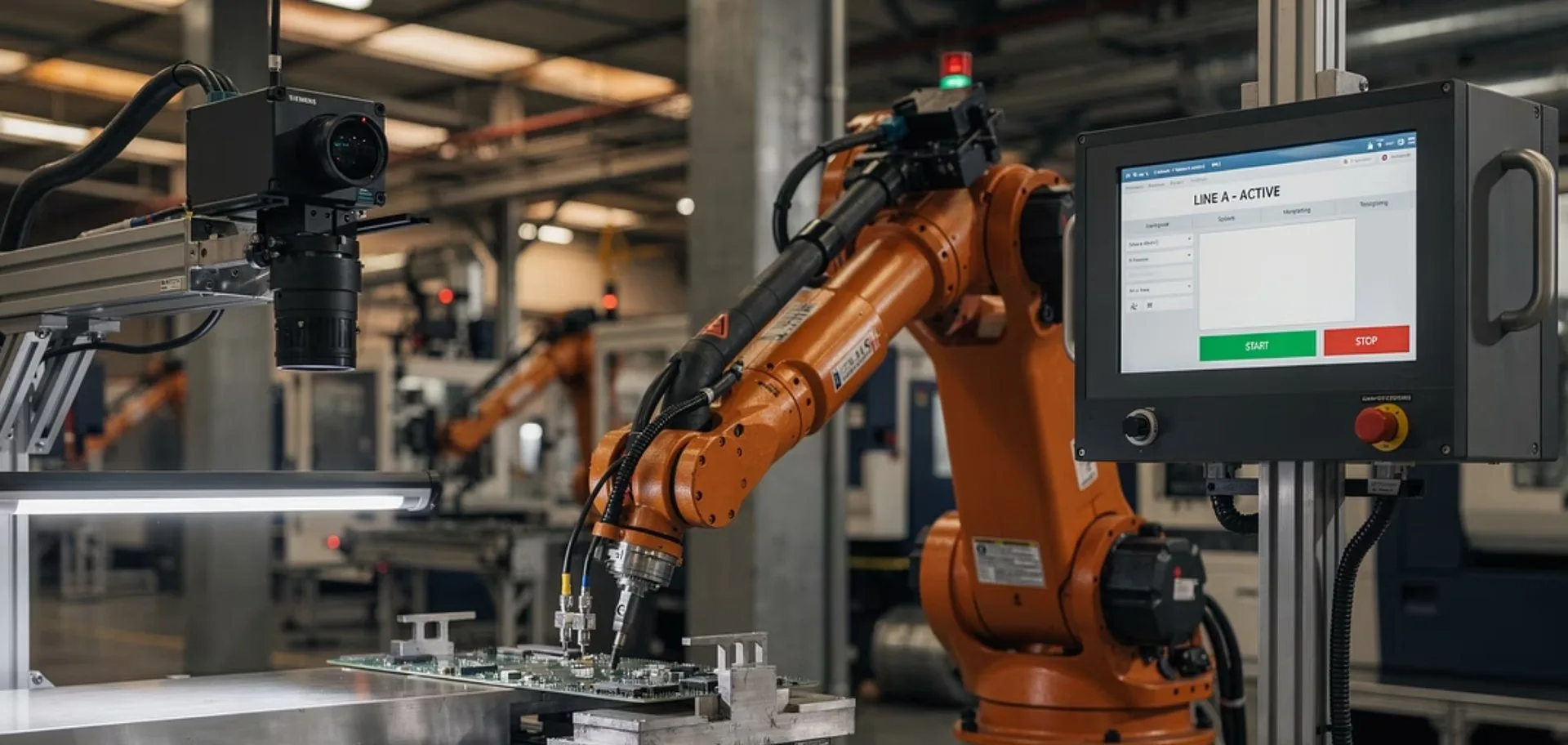
Industrial automation: a practical guide from a machinery manufacturer
What is industrial automation?
Industrial automation involves replacing manual operations within a production process with controlled systems that carry out the same tasks at greater speed, precision and repeatability. These systems combine hardware (PLCs, sensors, actuators, robots) and software (control programmes, HMI interfaces, SCADA systems) to manage the process without continuous human intervention.
In Spain, 5,160 industrial robots were installed in 2024, a 2.1 % increase over 2023 (IFR, 2024). This makes Spain the third-largest European market for robot installations, behind only Germany (27,031) and Italy (8,915). However, whilst 70 % of large Spanish companies already automate their processes, only 30 % of SMEs have taken this step (IFAMAC, 2025).
At MECVIL we do not simply recommend automation — we design it, build it, programme it and commission it. Our electrical engineering and automation department has delivered more than 18 projects involving robots, PLCs, machine vision and automated assembly lines for sectors such as automotive, chemicals and heavy manufacturing.
Types of industrial automation
Automation is classified into three levels according to the degree of system flexibility:
Fixed automation
Designed to produce a single product in high volumes. The equipment is dedicated to one specific task and is not easily reconfigurable. Example: a bottling line or a dedicated transfer machining station.
Programmable automation
The system can be reprogrammed to manufacture different products in batches. This is common in CNC machining workshops, where the same machining centre runs different programmes depending on the part.
Flexible automation (FMS)
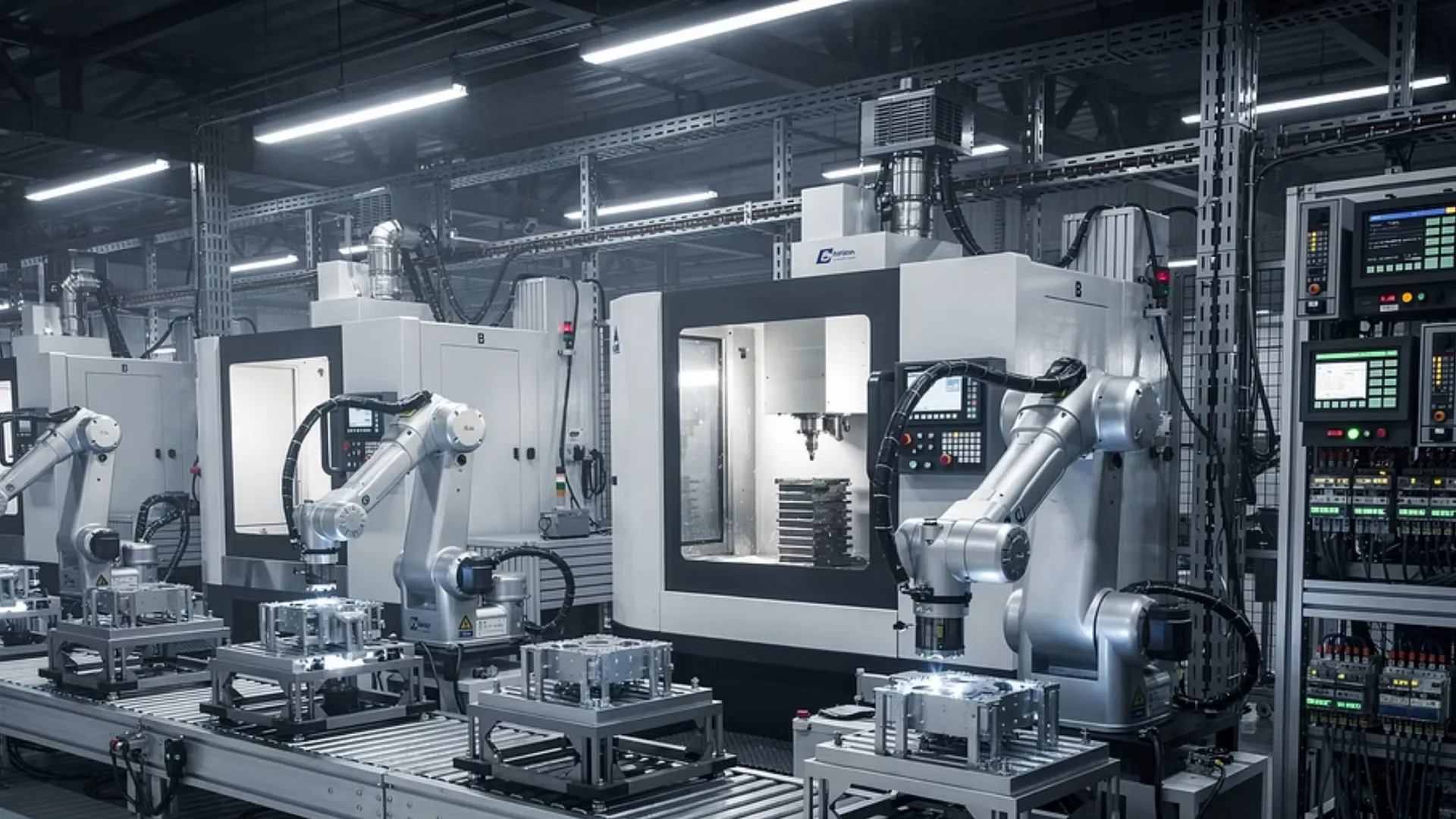
The most advanced level. Flexible Manufacturing Systems (FMS) combine robots, conveyors, workstations and control software to produce different products without stopping the line. At MECVIL we have designed and built multiple FMS lines:
- FMS line with 5 robots for automotive electronic component assembly, with machine vision and automatic screwdriving
- FMS line MT9 with 5 robots for assembly and depalletising, with machine vision and 4 automatic screwdriving stations
- FMS line V787 with 4 robots, 3 automatic screwdriving stations, 2 plasma treatment stations, adhesive and thermal paste application
These lines represent the state of the art in flexible automation: product changeover without stoppage, in-process verification and full traceability.
Need to automate a production line?
At MECVIL we design and build turnkey automated lines. Get in touch with our team to evaluate your project.
Key technologies in automation
An industrial automation project integrates several technologies that work in a coordinated manner:
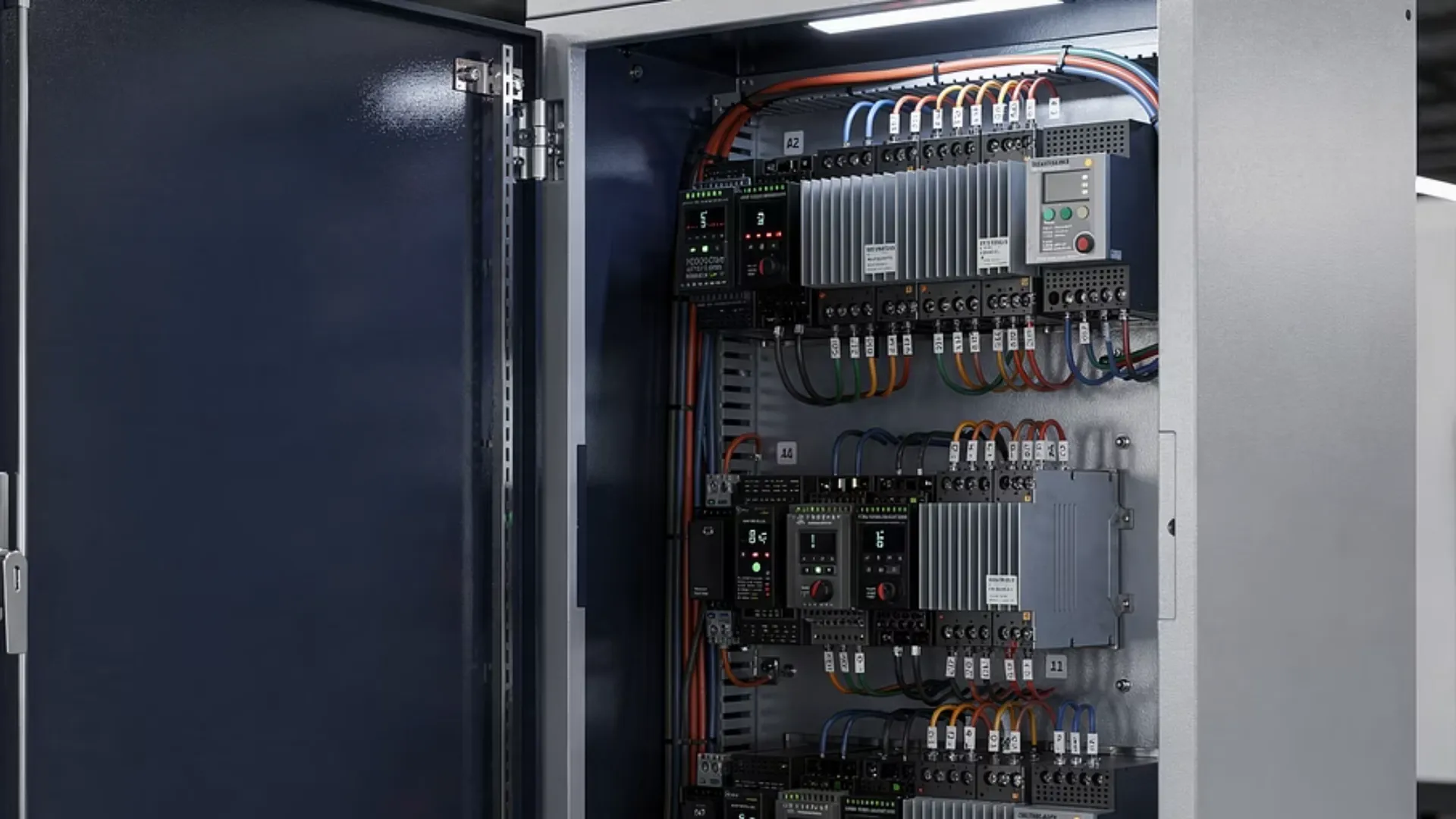
- PLC (Programmable Logic Controller): the brain of the system. At MECVIL we programme PLCs from the leading manufacturers — Siemens, Omron, Panasonic and Mitsubishi — adapting to each client's preferred brand.
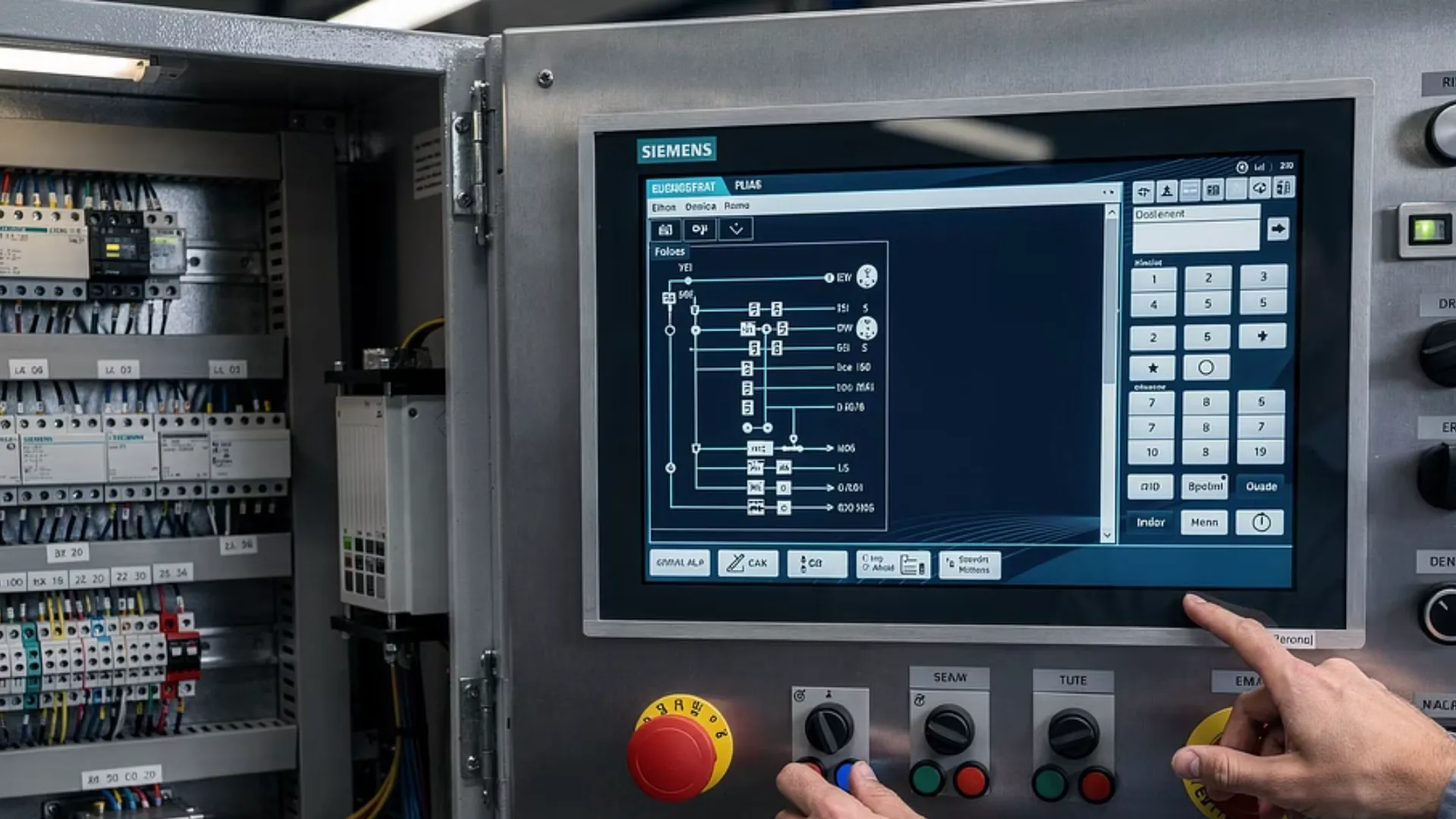
- HMI (Human-Machine Interface): screens that allow the operator to monitor the process and adjust parameters. We work with Siemens, Omron and Proface.
- Industrial robotics: robots for handling, welding, assembly and palletising. We have integrated robots in more than 10 projects, including robotic welding stations and cells with DENSO VS-068 robots.
- Machine vision: camera and image-processing systems for inspection, verification and robot guidance. We deploy AOI systems, 2D cameras, 3D profilometers and code readers.
- Servo motors and drives: precision motion control with regenerative braking energy recovery.
- Distributed peripheral systems: decentralised control architecture for large-scale installations.
The IEC 61131-3 standard defines the standard PLC programming languages (Ladder, Structured Text, Function Block). MECVIL works with all of them according to the project requirements.
Machine vision: quality built into production
Machine vision is one of the automation technologies offering the highest return on investment. It enables 100 % of production to be inspected in real time, without the errors and fatigue inherent in manual inspection.
At MECVIL we have integrated machine vision systems into real-world projects as part of our automation and electrical control service:
- AOI (Automated Optical Inspection): automatic inspection of components and assemblies without human intervention
- Electronic component verification on PCB: equipment adaptable to any product type, detecting assembly errors before they progress down the line
- Laser marking with vision verification: integration of assembly, marking and verification in a single flow for electronic controllers
- 3D profilometry and 2D inspection camera: monitoring of assembly with servo press, measuring force and position at every insertion
- Presence sensors and insertion verification: tooling with active detection that prevents parts with missing or incorrectly inserted components from advancing
These are not theoretical concepts — they are machines we build, programme and commission in our clients' actual production plants.
How much does automation cost, and what is the ROI?
Investment in industrial automation varies according to project complexity, but market data points to a clear return:
- Error reduction: between 70 % and 95 % in automated processes compared with manual ones (multiple industry sources, 2025)
- Productivity increase: between 25 % and 30 % with partial automation; up to 50 % in fully automated plants
- Payback period: between 6 months and 2 years for partial automation projects
For SMEs looking to begin their automation journey, public funding programmes are available such as the Kit Digital, Next Generation EU (PERTE Connected Industry) funds and CDTI grants for innovation projects.
The key to maximising ROI is to define the scope properly: there is no need to automate the entire plant at once. A phased approach — starting with bottlenecks or operations with the highest defect rates — delivers quick results and finances subsequent phases from the savings generated.
Turnkey automation: from design to commissioning
Most articles on industrial automation are written by consultancies or software vendors. But automating a production line requires far more than programming a PLC — it requires designing the process, manufacturing the machinery, assembling the electrical and mechanical components, programming, testing and commissioning.
At MECVIL we offer 360° integrated automation projects covering the entire cycle:
- 1.Conceptual engineering: analysis of the current process, solution definition and 3D CAD design
- 2.Detail engineering: electrical schematics (EPLAN, See Electrical), component selection, cycle time calculations
- 3.Mechanical manufacturing: CNC machining of baseplates, tooling and structures in our own facilities
- 4.Electromechanical assembly: mechanical, electrical, pneumatic and hydraulic assembly under one roof
- 5.Programming and commissioning: PLC, HMI, robots, vision — with factory acceptance testing (FAT) and site acceptance testing (SAT)
- 6.After-sales support: maintenance, spare parts supply and technical assistance
This vertical integration is what sets a machinery manufacturer like MECVIL apart from a pure integrator. We do not depend on third parties for any phase of the project, which shortens lead times, eliminates coordination issues and ensures the technical coherence of the result.
Automation trends for 2026
The industrial automation sector is evolving rapidly. These are the most relevant trends for machinery manufacturers and buyers:
- Collaborative robotics (cobots): the cobot market is growing at 20–32 % per year. Cobots work alongside the operator without safety enclosures, combining human flexibility with robotic precision. Ideal for SMEs beginning their automation journey.
- Digital twins: virtual replicas of the production line that allow changes to be simulated, processes to be optimised and operators to be trained before modifying the physical equipment.
- Predictive maintenance: IoT sensors on machines that anticipate failures before they occur, reducing unplanned downtime.
- Edge computing + 5G: data processing at the network edge (without relying on the cloud) for real-time machine vision and distributed control applications.
At MECVIL we integrate these technologies into our engineering and industrialisation projects, applying lean manufacturing principles so that automation is not an end in itself but a means of eliminating waste and improving efficiency.
Want to automate your production with a manufacturer that designs, builds and programmes under one roof?
At MECVIL we combine 50 years of industrial experience with cutting-edge automation technology. Contact our technical team to explore the possibilities for your project.