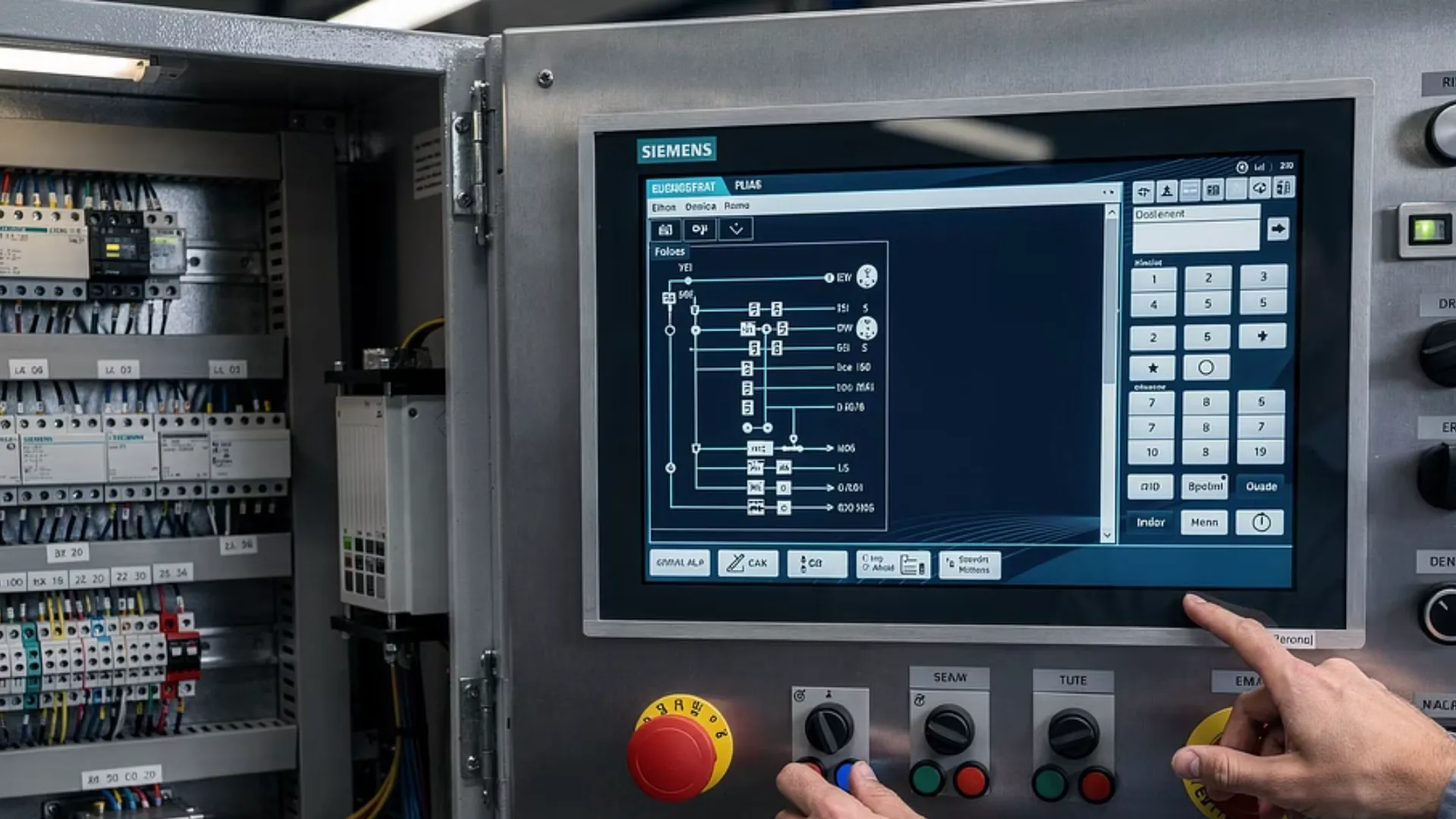
Siemens PLC Programming: Languages, Platforms and Industrial Applications
Siemens PLC programming is the discipline that defines the control logic of machines and production lines using SIMATIC programmable logic controllers. From managing a simple pneumatic cylinder to coordinating a robotised line with dozens of axes, the PLC is the brain that translates process requirements into reliable, safe and repeatable control sequences.
What is Siemens PLC programming
A PLC (Programmable Logic Controller) is an electronic controller designed for industrial environments that runs a cyclic programme: it reads inputs (sensors, push-buttons, analogue signals), processes the logic defined by the programmer and updates outputs (actuators, drives, valves). Through its TIA Portal platform, Siemens provides a unified environment where the PLC is programmed, the Profinet network is configured, the HMI screen is designed and faults are diagnosed in real time.
The main advantage of Siemens PLCs over traditional hard-wired logic is flexibility: changing machine behaviour requires only a programme modification, not a rewiring effort. This reduces commissioning times and enables the machine to be adapted to new products without mechanical intervention. In industrialisation projects, this reprogramming capability significantly shortens validation cycles.
Programming languages according to IEC 61131-3
The IEC 61131-3 standard defines five programming languages for PLCs. An experienced programmer selects the language best suited to each part of the process:
| Language | Abbreviation | Type | Typical application |
|---|---|---|---|
| Ladder Diagram | LD | Graphical | Switching logic, interlocks, start/stop |
| Function Block Diagram | FBD | Graphical | PID loops, analogue regulation, signal processing |
| Structured Text | ST | Textual | Mathematical calculations, recipe management, communications |
| Sequential Function Chart | SFC | Graphical | Process sequences, step-by-step automatic cycles |
| Instruction List | IL | Textual | Performance optimisation (legacy use, replaced by ST) |
In industrial practice, most projects combine LD for basic switching (motor starts, safety management) and ST for advanced logic (communication protocols, traceability, position calculations). SFC is particularly useful for programming machine cycles with defined stages, such as those found in automated assembly lines.
Siemens platforms: S7-1200 vs S7-1500
Siemens offers two PLC families within TIA Portal, each aimed at a different application range:
S7-1200: a compact controller designed for standalone machines and medium-complexity applications. It includes integrated I/O, native Profinet communication and expansion modules for additional analogue or digital signals. Its typical cycle time is in the millisecond range, sufficient for most individual machines.
S7-1500: a high-performance platform for complex production lines, robotised cells and processes demanding deterministic communications. It offers significantly lower cycle times, an integrated web server, advanced diagnostic functions and native OPC-UA support, facilitating integration into Industry 4.0 architectures.
The choice between the two platforms depends on the number of axes to control, communication complexity, response-time requirements and project budget. At MECVIL, our automation engineers select the optimal platform during the engineering phase, ensuring the solution covers current needs and allows for future expansion.
When does your project need PLC programming?
PLC programming is essential when an industrial process requires:
- Automated sequences: machine cycles with defined stages, controlled timings and transitions conditioned by sensor signals.
- Motion control: axis positioning via servo drives, axis synchronisation, trajectory interpolation.
- Safety management: emergency-stop circuits, access guarding, safe-speed monitoring in accordance with EN ISO 13849.
- Communication with other equipment: data exchange with robots, machine-vision systems, scales or MES/SCADA systems.
- Traceability: logging of production parameters, recipe management, quality-data storage.
If your project involves any of these requirements, you need an engineering team that masters both PLC programming and integration with other disciplines (mechanical, electrical, pneumatic). Programming in isolation, without process knowledge, produces fragile solutions that are difficult to maintain.
Multi-brand PLC programming: beyond Siemens
Although Siemens dominates the European PLC market, many industrial projects require working with other brands — whether specified by the end customer, needed for compatibility with existing installations, or driven by cost requirements. A versatile integrator must command multiple platforms:
- Omron (NX/NJ): strong in motion control and high-speed applications. Sysmac Studio programming environment.
- Panasonic (FP-X): a compact, cost-effective solution for medium-complexity machines. Widely used in packaging and handling machinery.
- Mitsubishi (iQ-R/iQ-F): well-established presence in automotive and discrete manufacturing. GX Works environment.
In every case, PLC programming is complemented by HMI screen design (Siemens, Omron, Proface), electrical schematics in EPLAN or See Electrical, and distributed I/O network configuration via Profinet or EtherCAT. To learn how automation fits into a complete project, see our industrial automation guide.
Industrial PLC programming at MECVIL
MECVIL has a dedicated electrical and electronic section with a capacity of 1,500 hours/month of electronic engineering, focused on PLC programming, electrical-panel design and commissioning of automated installations. Our team of over 30 engineers programmes Siemens PLCs (S7-1200, S7-1500), Omron (NX/NJ), Panasonic (FP-X) and Mitsubishi (iQ-R/iQ-F) for projects ranging from individual machines to complete turnkey lines.
Every project includes:
- Functional analysis and control-architecture definition
- PLC programming and HMI screen design
- Electrical schematics in EPLAN or See Electrical
- Custom electrical panel manufacturing
- Profinet/EtherCAT network and servo-drive configuration
- Commissioning at our 10,500 m² facilities and at the customer's site
ISO 9001 certification, more than 110 professionals and nearly 50 years of experience in industrial machinery back every programme delivered by our department. If you need to design a complete electrical cabinet with its programming, we integrate both disciplines into a single project.
Need PLC programming for your machine or production line?
Request a quotation and our automation department will analyse your project's control requirements.