
Industrial CNC turning: a practical guide from the manufacturer
What is CNC turning?
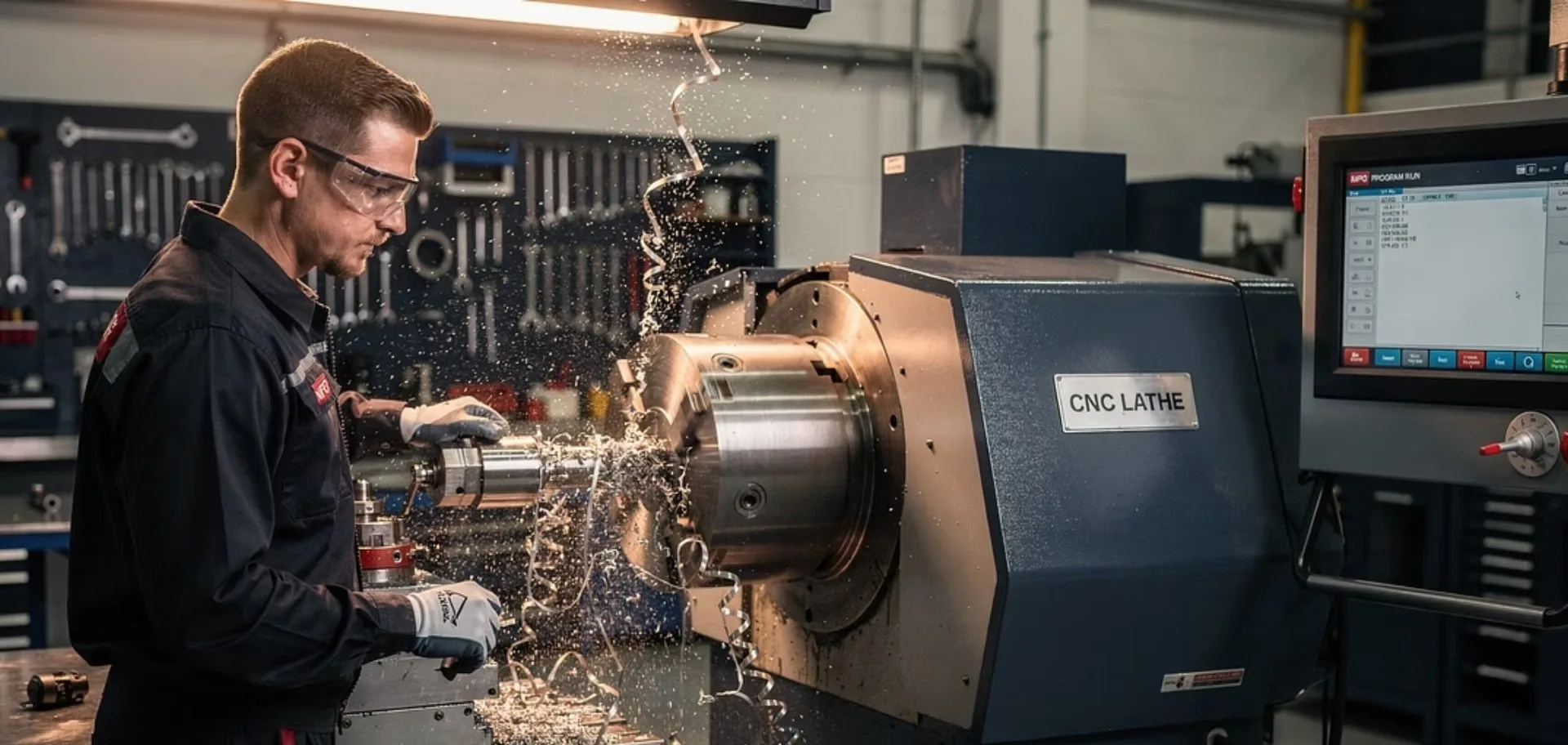
CNC turning is a machining process in which the workpiece rotates about its axis whilst a single-point cutting tool removes material to create cylindrical, conical and threaded forms. Unlike CNC milling, where the tool rotates, in turning it is the workpiece that moves.
Computer numerical control (CNC) enables the programming of complex toolpaths with repeatable precision of ±0.002 mm between consecutive parts. This makes CNC turning the reference process for manufacturing shafts, bushings, sleeves, fittings, flanges and any component with rotational symmetry.
At MECVIL, CNC turning is one of the core capabilities of our machining service, alongside milling, grinding and coordinate measuring. We operate high-capacity CNC lathes across more than 10,500 m² of facilities, with experience spanning 13 industrial sectors.
CNC turning operations
CNC turning is not limited to reducing the diameter of a bar. It encompasses a set of operations that, combined, allow complete parts to be manufactured without changing machines:
- Cylindrical turning: reduction of the outside diameter to the specified dimension. This is the fundamental lathe operation.
- Facing: machining the front face of the workpiece to create flat surfaces perpendicular to the axis.
- Boring: enlargement and finishing of internal holes with control of diameter, cylindricity and surface finish.
- Threading: creation of internal and external threads through programmed cutting cycles. Metric, Whitworth, trapezoidal and special threads.
- Grooving: cutting channels, O-ring seats and keyways into the workpiece surface.
- Parting off: separation of the finished part from bar stock using a radial cut-off tool.
- Taper turning: manufacture of conical surfaces at a controlled angle, common in Morse tapers and valve seats.
- Contour turning: generation of complex curved profiles following toolpaths programmed in the CNC.
- Knurling: impression of textured patterns (diamond, straight) to improve manual grip on the part.
These operations are chained into a single CNC programme, reducing production times and eliminating repositioning errors between phases.
Do you need turned parts for your industrial project?
Request a quotation and our engineering team will evaluate your drawings and specifications.
Materials we machine by turning
Each material behaves differently on the lathe. The choice of tooling, cutting speeds and coolant depends directly on the workpiece material:
- Aluminium (6061-T6, 7075): excellent machinability, permits high cutting speeds and fine surface finishes. Ideal for aeronautical components and structural aluminium machining.
- Carbon steel (1018, 1045, 4140): versatility and a good cost-to-performance ratio. Used for shafts, gears and structural components.
- Stainless steel (304, 316, 17-4 PH): corrosion-resistant but prone to work hardening. Requires coated carbide tooling and generous coolant supply.
- Titanium (Ti-6Al-4V): exceptional strength-to-weight ratio for aerospace components. Low cutting speeds, specialised tooling and rigorous chip evacuation.
- Brass (C360): regarded as the reference material in turning due to its ease of machining. Used for fittings, valves and connectors.
- Engineering plastics (POM, PEEK, nylon): low cutting forces but heat-sensitive. Require sharp tooling and controlled speeds to prevent melting.
At MECVIL we select the optimum cutting strategies for each material, drawing on more than 50 years of accumulated experience in turning industrial components.
Tolerances and surface finish
The ability to achieve tight tolerances repeatably is what sets industrial CNC turning apart from conventional turning.
| Precision level | Tolerance | Typical application |
|---|---|---|
| Standard | ±0.1 mm | General production, non-critical components |
| Precision | ±0.02 mm | Bearing seats, sealing surfaces |
| High precision | ±0.005 mm | Aerospace components, instrumentation |
The most common reference on industrial drawings is ISO 2768-mK. For cylindrical parts, fit tolerances are specified according to ISO 286 (shaft-and-hole system), which defines tolerance grades IT5 to IT8 depending on the criticality of the application.
The surface finish achievable by CNC turning depends on the cutting parameters and tooling:
- Ra 3.2 µm: standard turning finish, no additional operation
- Ra 1.6 µm: finishing pass with reduced feed and wiper insert
- Ra 0.8 µm: fine turning with optimised parameters, equivalent to grinding in some materials
- Ra 0.4 µm: requires cylindrical grinding as a secondary operation
For sealing surfaces and bearing seats, Ra 0.8 µm or below is typically specified. Improving the finish from Ra 3.2 to Ra 0.8 µm increases machining cost by between 200 % and 400 %, which is why it is important to specify only the roughness strictly required for each functional surface.
When to choose turning and when milling?
The decision between turning and CNC milling depends fundamentally on the geometry of the part:
- Turning: parts with rotational symmetry — shafts, bushings, flanges, threads, tapers. The workpiece rotates and the tool moves along 2 axes (X, Z).
- Milling: prismatic parts or those with complex surfaces — housings, frames, cavities, 3D profiles. The tool rotates across 3 to 5 axes.
In practice, many parts require both processes. A shaft may need turning for the diameter and milling for a keyway or flat surface. Multi-tasking machines (mill-turn centres) integrate both operations in a single set-up, eliminating repositioning time. The CNC multi-tasking centre market reached 5,200 million dollars in 2024 and is projected to grow at a rate of 9.4 % per year through to 2033 (OpenPR, 2025).
At MECVIL, the combination of CNC lathes and machining centres of up to 20 metres allows us to manufacture complete parts requiring both processes without the need for subcontracting.
Applications by industrial sector
CNC turning is a cross-cutting process that serves manufacturing needs in virtually every industrial sector. At MECVIL we work with 13 sectors and these are the ones with the highest demand for turning:
- Hydraulics: pump shafts, valve bodies, high-pressure fittings. Our hydraulic tube winder project includes turned components with integrated pressure testing.
- Automotive: transmission shafts, bushings, spacers, exhaust flanges. Turning feeds the automated assembly lines that we design and manufacture.
- Heavy manufacturing: rollers for calenders and rolling mills, large-diameter shafts, pedestal bushings. Our roller construction project is an example of CNC turning with exacting dimensional requirements.
- Energy: components for generators, turbines and rotating equipment. Large-diameter, long cylindrical parts.
- Graphic arts and paper: unwinder and rewinder shafts for packaging lines, where concentricity and surface finish are decisive.
Criteria for choosing a CNC turning supplier
When looking for an industrial CNC turning supplier, evaluate:
- 1.Chuck capacity and distance between centres: determines the maximum diameter and length of part that can be manufactured
- 2.Documented precision: request dimensional inspection reports for parts similar to yours
- 3.Certifications: ISO 9001 quality management, with quality-controlled welding for metal structures if the part forms part of a welded assembly
- 4.Process integration: a supplier that also offers engineering, milling, grinding and assembly saves you coordination effort and transport time between workshops
- 5.Dimensional control: coordinate measuring systems with documented traceability
- 6.Sector experience: familiarity with the standards and requirements of your industry
An integrated manufacturer like MECVIL, with turnkey project capability, can manage everything from part design through to final delivery — assembled and verified — all under one roof.
Looking for a CNC turning partner with integrated capabilities?
At MECVIL we combine CNC lathes, milling machines of up to 20 metres, grinders and 3D measuring systems. Contact our engineering team to discuss your project.