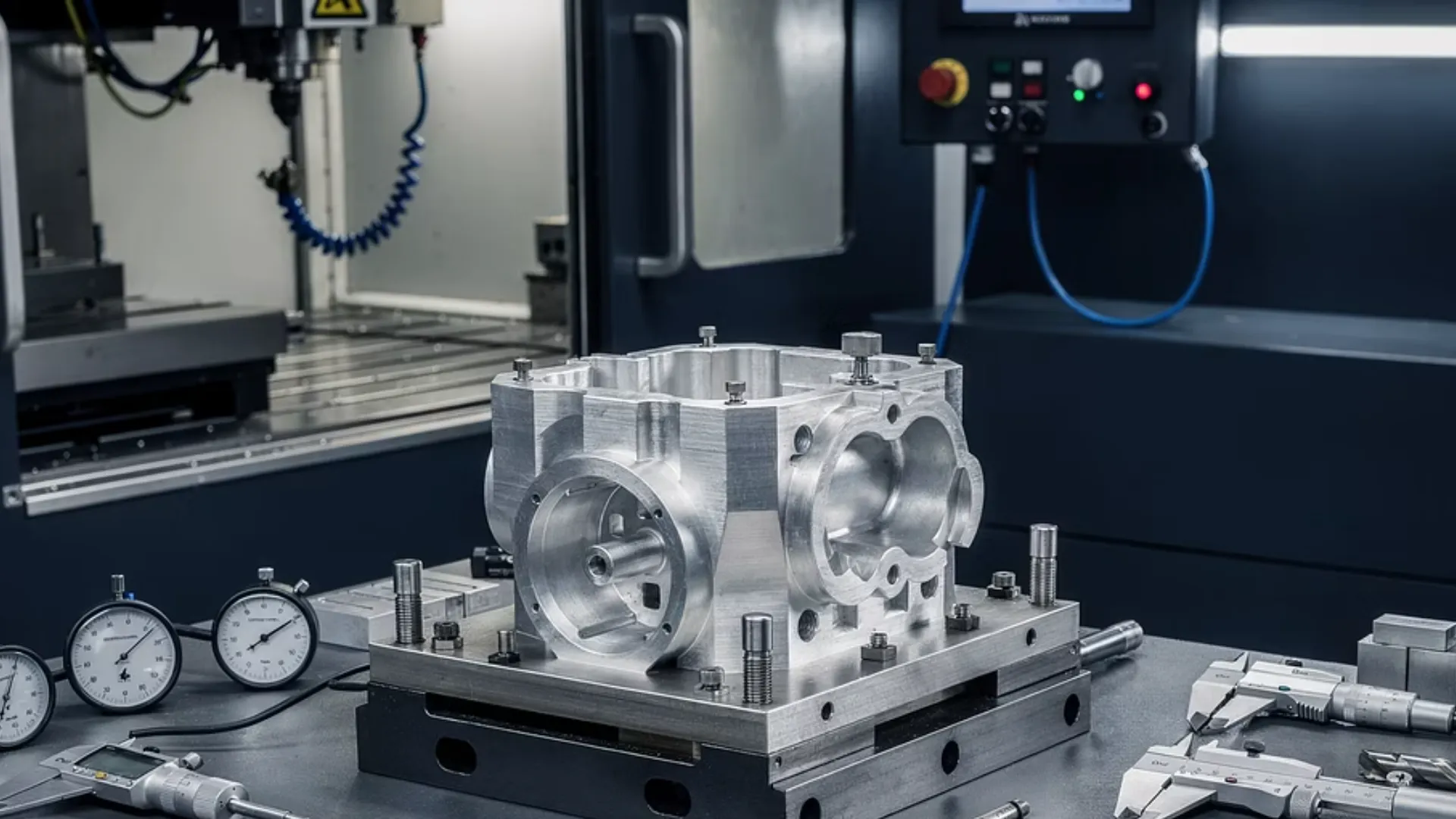
Jig and Fixture Manufacturing: Types, Materials and Quality Criteria
In jig and fixture manufacturing, the outcome determines whether production processes run stably, repeatably and independently of the operator — or whether dimensional deviations, rework and scrap drive up costs. Every clamping fixture, assembly fixture and inspection fixture is a one-off, engineered for a specific manufacturing step. Companies that lack this competence in-house outsource fixture manufacturing to specialised partners — a trend that continues to gain momentum amid the growing shortage of skilled professionals across European industry.
What is jig and fixture manufacturing
Jig and fixture manufacturing — also referred to as production tooling — encompasses the design and fabrication of devices that hold workpieces in a defined position during forming and machining processes. The base standard DIN 6300:2009-04 defines the terminology and abbreviations for these production aids.
Fixtures fulfil three core functions:
- Positioning — holding the workpiece in the correct orientation relative to the tool or measuring system
- Clamping — securing the workpiece against machining forces
- Guiding — directing tools or components along defined paths
The quality of a fixture directly determines process stability: cycle time, scrap rate and operator independence all depend on the dimensional accuracy and rigidity of the fixture.
Types of fixtures in industrial manufacturing
Fixture manufacturing distinguishes five principal types according to their purpose:
| Fixture type | Function | Requirements |
|---|---|---|
| Clamping fixture | Workpiece fixation during machining | Repeatability, rigidity, accessibility for tool paths |
| Assembly fixture | Guidance during sub-assembly | Ergonomics, Poka-Yoke (error proofing), cycle time optimisation |
| Welding fixture | Component fixation despite thermal distortion | Heat resistance, thermal expansion compensation |
| Inspection fixture | Quality control and measurement | Measurement accuracy, traceability, integration into ISO 9001 processes |
| Milling fixture | Workpiece positioning for CNC machining | Vibration damping, swarf evacuation, high clamping forces |
In the automotive industry, individual fixtures are required for virtually every vehicle component — from body-in-white and interior trim through to engine assembly. These fixtures must maintain dimensional accuracy over millions of cycles.
Materials in fixture manufacturing
Material selection in fixture manufacturing depends on the type of loading, the required service life and the environmental conditions:
- Quenched and tempered steel (C45, 42CrMo4) — Standard material for dynamically loaded fixture components. Carbon content of 0.20–0.60%, tempered at 550–700 °C for the optimum balance of hardness and fracture toughness.
- Tool steel (1.2312, 1.2343) — For wear-resistant functional surfaces. Alloying elements tungsten, vanadium, molybdenum and chromium increase service life.
- Aluminium — For lightweight fixtures that require frequent changeover or manual handling. Reduces operator strain.
- Stainless steel — For corrosion-resistant fixtures in the food and pharmaceutical sectors.
For functional surfaces with demanding dimensional accuracy requirements, hardened inserts and replaceable wear parts are employed after wire EDM and precision machining.
Do you require bespoke fixtures for your production process?
Request a quotation — our design team will analyse your requirements.
Which standards apply to fixture manufacturing
The normative framework for fixture manufacturing comprises:
- DIN 6300:2009-04 — Base standard for fixtures: terminology and abbreviations
- DIN ISO 2768-1 — General tolerances for linear and angular dimensions (classes f, m, c, v). Class "m" is the most widely used in mechanical engineering.
- DIN ISO 2768-2 — General tolerances for form and position (classes H, K, L)
- DIN EN ISO 9001 — Quality management system. Essential basis for any fixture manufacturing service provider.
- DIN EN ISO 12100 — Safety of machinery. Risk assessment is also relevant for fixtures.
Compliance with general tolerances per DIN ISO 2768 ensures that fixtures guarantee the dimensional accuracy of manufactured workpieces — without the need to tolerance every individual dimension separately.
Why outsource fixture manufacturing
Fixture manufacturing demands specialist competence in design, material selection and precision CNC machining. For OEMs and machinery manufacturers whose core competence lies in development and sales, in-house fixture production is often uneconomical.
Advantages of outsourcing:
- Design competence without a dedicated department — Access to experienced designers with CAD/CAM and FEA simulation
- Machine park without capital investment — 5-axis machining, wire EDM, grinding
- Capacity flexibility — Fixtures on demand without maintaining internal capacity
- Overcome the skills shortage — Qualified CNC specialists and designers without recruitment
- Faster turnaround — Specialised partners draw on accumulated experience that reduces lead times
The trend towards modular fixture construction (building-block principle) — standardised base bodies with configurable modules — further reduces costs and lead times.
Fixture manufacturing at MECVIL: integrated engineering and CNC production
Fixture manufacturing unites design engineering with precision machining. That is why a partner with end-to-end competence — from 3D design through to the finished fixture — is decisive.
MECVIL has an engineering team of 30+ engineers with 3,000 hours/month of design capacity. We work with 3D-CAD/CAM, FEA simulation and validate designs using Virtual Reality before production.
Our CNC capacity for fixture manufacturing includes:
- Fixed-bed milling machines with up to 20 metres of travel — including for oversized fixtures
- Simultaneous [5-axis machining centres](/en/servicios/mecanizado/mecanizado-5-ejes) — complex contours in a single set-up
- Wire EDM — for hardened materials and tight tolerances
- Turning, grinding — complete machining chain in-house
- 5,000 hours/month of machine capacity
Because we combine fixture manufacturing with assembly (5,000 h/month) and electrical engineering under one roof, we also deliver fixtures that integrate directly into automated production lines — as part of turnkey projects.
Planning a fixture manufacturing project? Contact MECVIL for a no-obligation quotation. ISO 9001 certified, 50 years of manufacturing experience, CNC precision up to 20 metres.