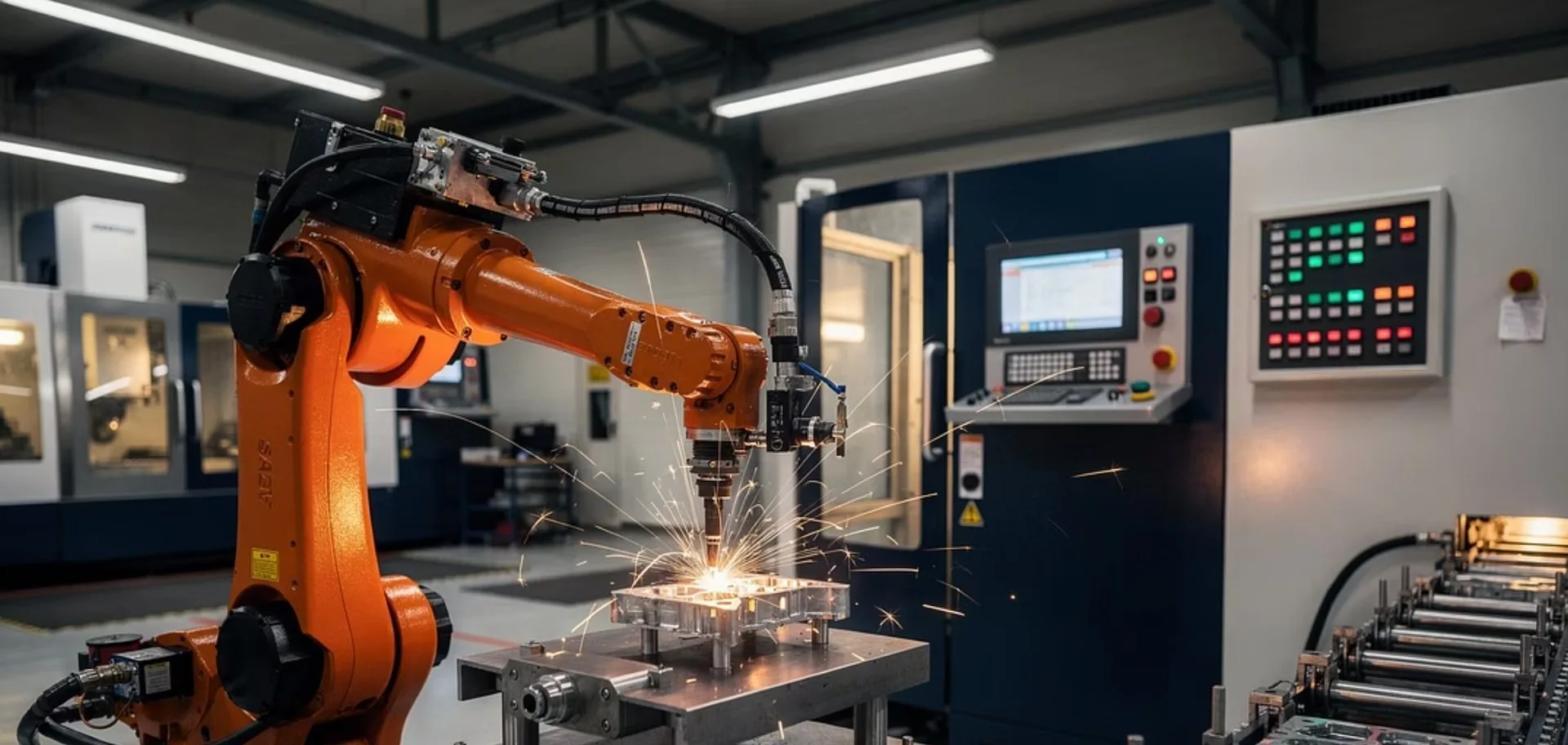
Industrial robotics: a practical guide from a machinery manufacturer
What is industrial robotics and why is it growing in Spain?
Industrial robotics applies programmable robots to manufacturing tasks such as welding, assembly, handling, inspection and palletising. These systems carry out repetitive operations at superior speed, precision and consistency compared with a manual operator, freeing people for higher value-added tasks.
Spain installed 5,160 industrial robots in 2024, consolidating its position as the third-largest European country for installations, behind only Germany (27,031) and Italy (8,915), according to the International Federation of Robotics (IFR, 2024). Robot density in the Spanish manufacturing industry reaches 174 units per 10,000 employees, compared with a global average of 162 (IFR, 2023). In the automotive sector, that figure soars to 894 robots per 10,000 workers.
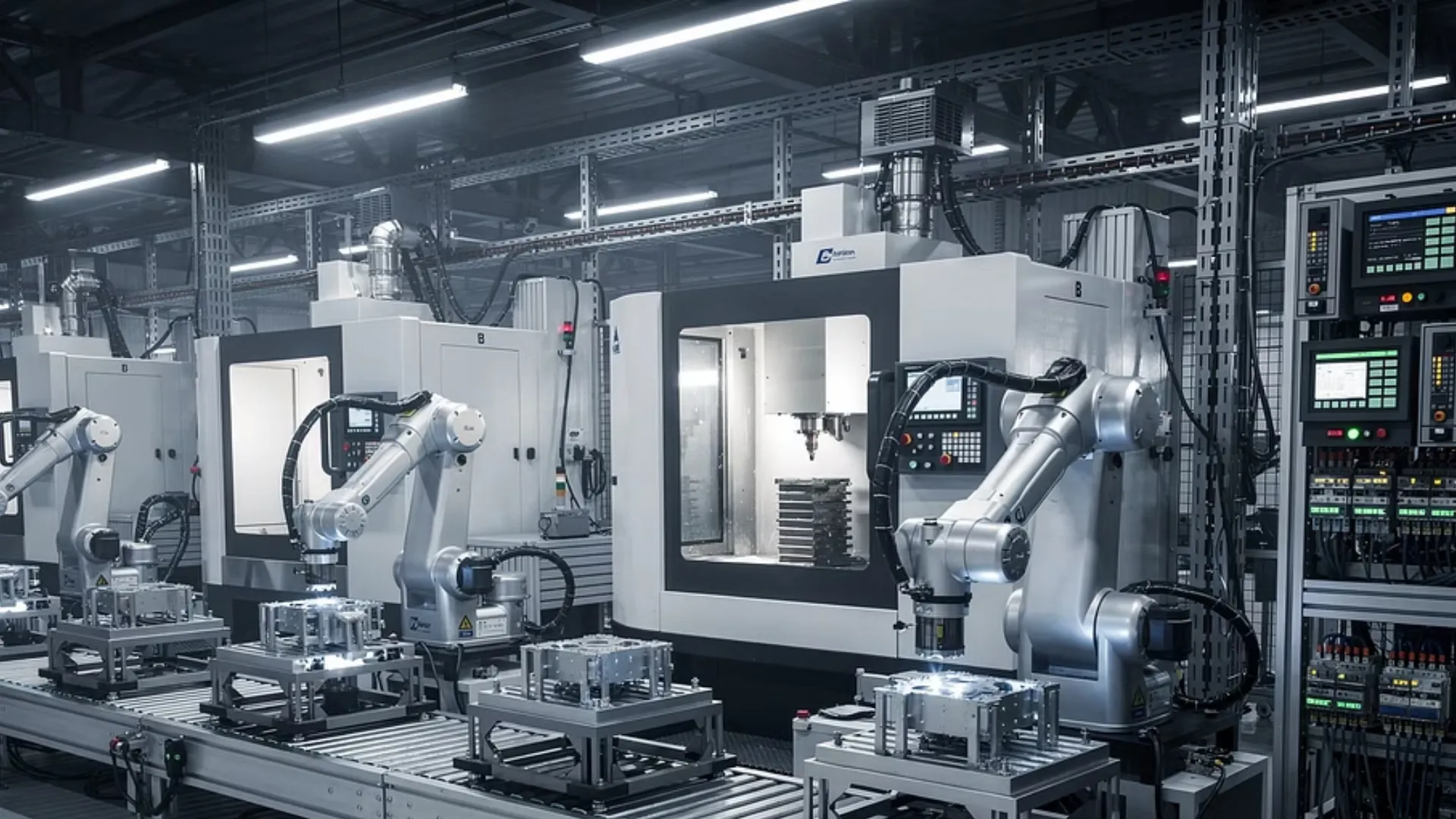
At MECVIL, we do not sell robots: we integrate them into special-purpose machinery that we design and manufacture. Our electrical engineering and automation department has integrated robots into more than 18 projects, including 3 FMS lines with a total of 14 industrial robots.
Types of industrial robot
The choice of robot type depends on the application, payload, reach and speed required:
| Type | Axes | Typical payload | Main applications |
|---|---|---|---|
| Articulated | 4–6+ | 5–2,300 kg | Welding, assembly, heavy handling |
| SCARA | 4 | 1–20 kg | Precision pick & place, electronics |
| Delta | 3–4 | 0.5–8 kg | High-speed packaging, food handling |
| Cartesian | 3 | Variable | Dispensing, cutting, linear movements |
| Collaborative (cobot) | 6–7 | 3–25 kg | Assembly alongside operators, loading/unloading |
The 6-axis articulated robot is the most widespread type in industrial manufacturing because it offers the greatest versatility: it can reach any point within its working envelope from any orientation. It is the type we use in most of our FMS lines and welding cells.
Industrial robot or cobot? When to use each
One of the most frequent questions from our clients is whether they need a conventional industrial robot or a cobot (collaborative robot). The answer depends on the process:
Choose an industrial robot when:
- The application demands high speed and cycle rates (seconds-long cycles)
- The payload exceeds 25 kg
- The environment requires a closed cell with safety fencing
- Maximum precision and repeatability are needed (±0.02 mm)
- Production is stable and product changeovers are infrequent
Choose a cobot when:
- The robot works alongside operators without safety fencing
- Production is low-volume and highly variable
- Frequent reprogramming for new tasks is required
- Available floor space is limited
- The company is looking for an accessible first step towards automation
At MECVIL, we integrate both types of robot according to project requirements. Our electrical section confirms that _we integrate industrial robots and cobots into existing or new production lines, including machine vision and Deep Learning systems_. The typical return on investment for a partial robotisation project is between 12 and 18 months, with savings of 25–40% on direct labour costs (Universal Robots, 2025).
Need to integrate robotics into your production line?
Request a technical consultation and we will jointly assess the best configuration for your process.
Real-world applications: how we integrate robots into industrial machinery
The difference between writing about robotics and applying it lies in real projects. At MECVIL, we have integrated robots in the following configurations:
FMS lines with multiple robots
We have designed and manufactured 3 flexible manufacturing system (FMS) lines for the assembly of automotive electronic components:
- FMS line with 5 robots: electronic component assembly with machine vision and automatic screwdriving
- FMS MT9 line with 5 robots: assembly and depalletising with machine vision and 4 automatic screwdriving units
- FMS V787 line with 4 robots: 3 automatic screwdriving units, 2 plasma stations, adhesive and thermal paste dispensing
Each line integrates articulated robots, machine vision systems for in-process verification, and communication with a central PLC for full traceability.
Robotic welding cells
We manufacture robotic welding stations with an integrated robot and welding unit, as well as cells with two robots for simultaneous operations. Tooling trolleys allow the cell to be fed whilst the robot welds, maximising productive time.
Robotics with machine vision
More than 8 projects combine robots with machine vision systems for AOI inspection, PCB component verification, laser marking with integrated verification, and supervision using a servo press, 2D camera and 3D profilometer.
Tooling for specific robots
We design and manufacture workpiece-holding tooling adapted to specific robot models, such as the DENSO VS-068, to ensure maximum precision in automated handling.
Complete integration: from engineering to commissioning
Integrating a robot into a production line requires much more than purchasing the robot and programming it. It demands a comprehensive process covering the mechanical, electrical and software dimensions:
- 1.Conceptual engineering: process definition, robot selection (brand, model, reach, payload) and cycle simulation
- 2.Mechanical design: CNC machining of baseplates, tooling, grippers and cell structures
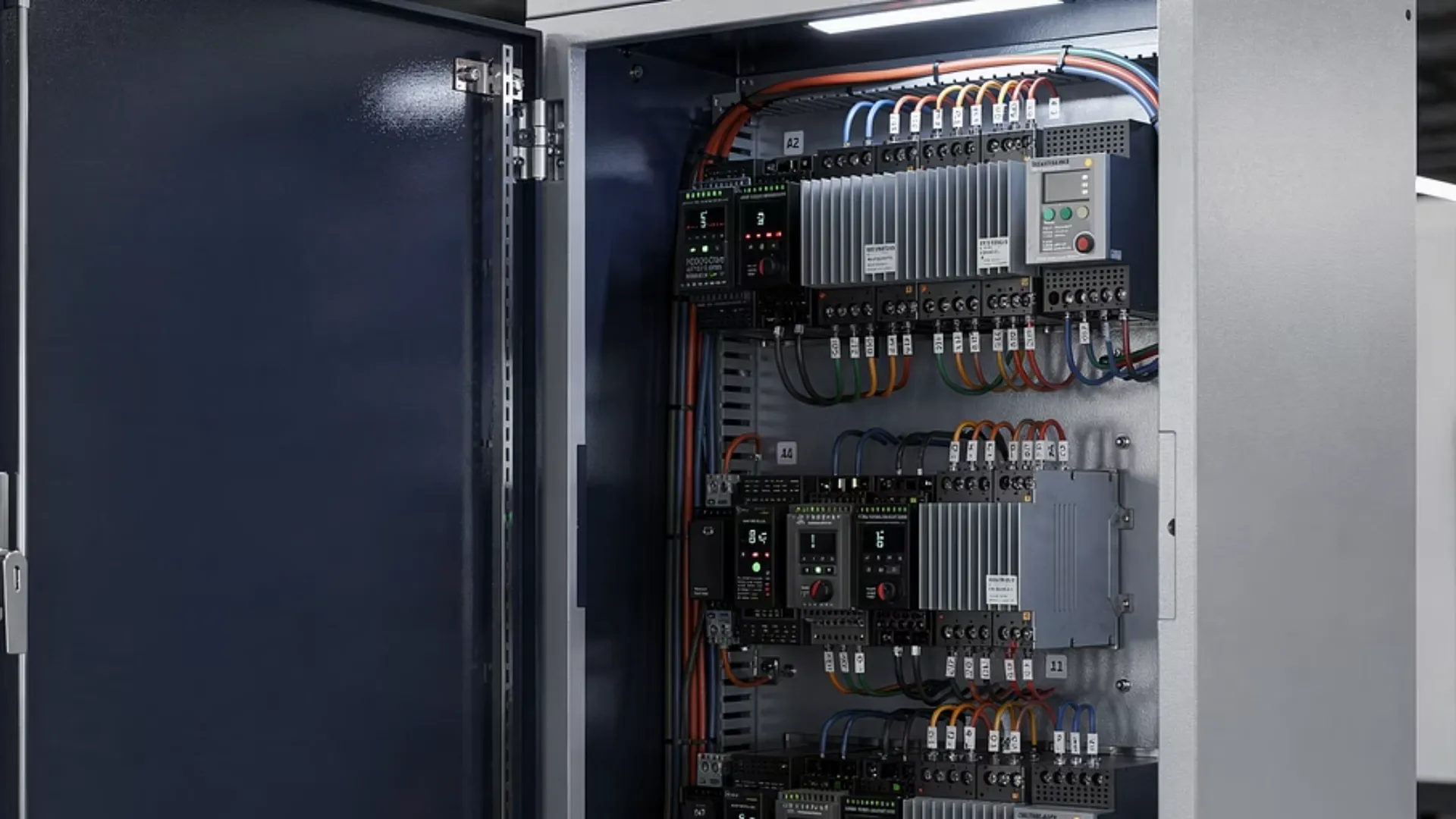
- 3.Electrical engineering: electrical panel design with EPLAN, selection of power and control components
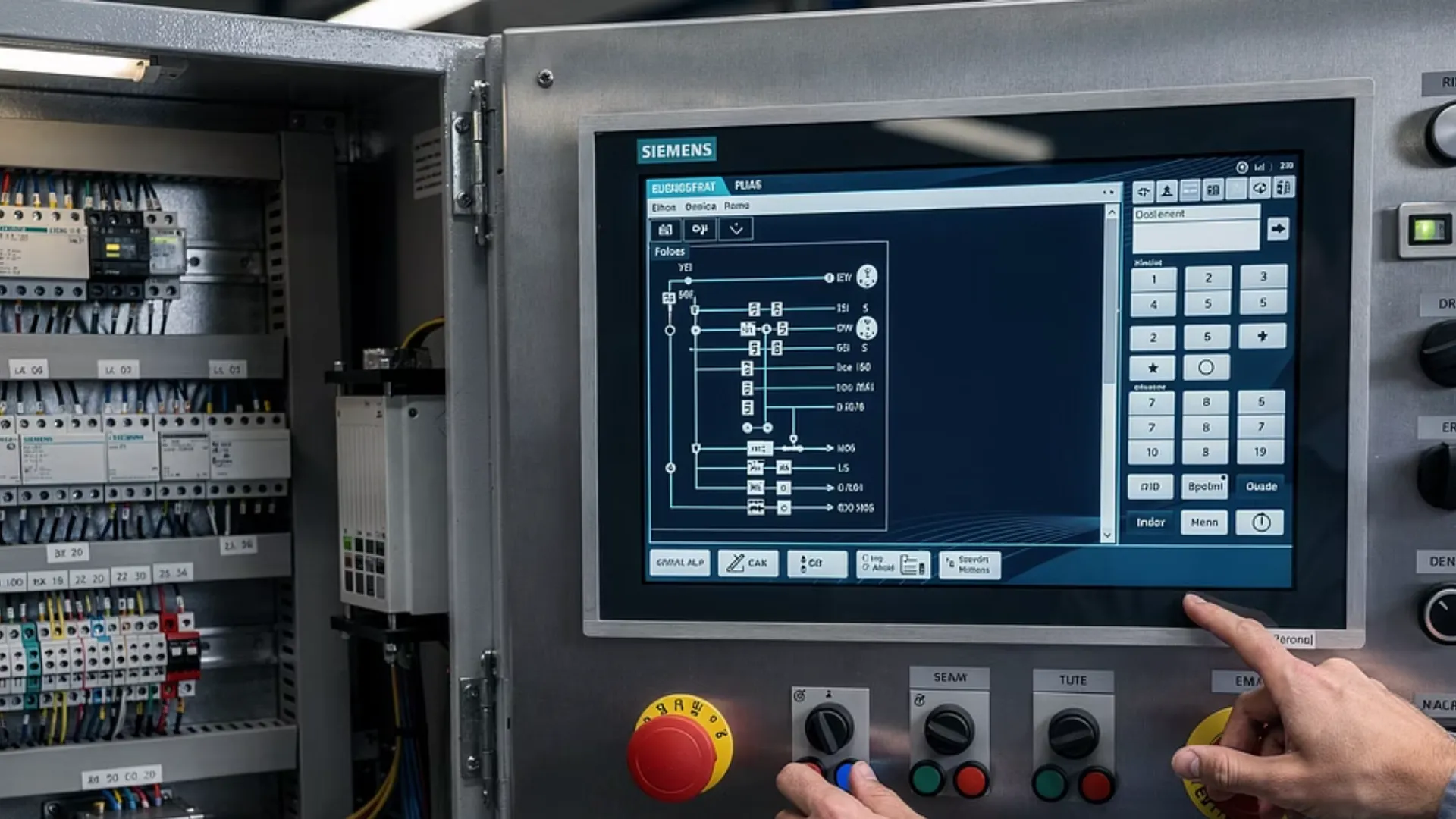
- 4.Programming: PLC (Siemens, Omron, Panasonic, Mitsubishi), HMI (Siemens, Omron, Proface), robot trajectories
- 5.Vision integration: camera calibration, inspection algorithms, QR/barcode readers
- 6.Factory acceptance testing (FAT): functional testing at our assembly facilities before shipment
- 7.Site acceptance testing (SAT): installation, fine-tuning and training of client personnel
At MECVIL, we carry out all 7 phases under one roof, as part of our 360° turnkey service. We do not subcontract robot programming or electrical integration: everything is managed in-house with a single point of contact.
Sectors investing most in industrial robotics
According to IFR data for Spain (2024), the sectors with the highest investment in industrial robotics are:
- Automotive: 2,278 robots installed in 2024, accounting for 44% of the national total. This is our sector with the greatest number of automation projects.
- Food and beverages: 25.3% year-on-year growth, driven by palletising, packaging and hygienic handling.
- Electrical and electronics: 118% year-on-year growth, led by miniaturisation and quality requirements in assembly.
At MECVIL, we serve 13 industrial sectors, with particularly relevant experience in automotive, chemicals, heavy manufacturing and the hydraulic sector.
Industrial robotics trends for 2026
The industrial robotics sector is moving towards greater flexibility, intelligence and accessibility:
- Cobots with greater autonomy: collaborative robots are incorporating ever more sensory and decision-making capability, approaching the autonomy of an industrial robot in low-payload applications.
- Integrated AI and machine vision: Deep Learning algorithms that enable the robot to adapt to variations in the workpiece or environment without manual reprogramming.
- Autonomous mobile robots (AMR): platforms that move around the plant autonomously, replacing fixed-rail AGVs.
- Accessibility for SMEs: falling sensor and software prices, combined with simplified programming interfaces, are making robotics accessible to companies that previously could not afford it. Only 30% of Spanish SMEs have automated their processes (IFAMAC, 2025), representing an enormous opportunity.
At MECVIL, we integrate these trends into our projects, applying lean manufacturing principles to ensure that robotics investment delivers measurable returns from the first year.
Want to automate with robotics and a single partner that designs, manufactures, programmes and commissions?
At MECVIL, we have integrated 14 robots across 3 FMS lines, plus welding cells and machine vision systems. Get in touch with our technical team to explore your project.