
Industrial Electrical Switchgear: Components, Standards and Design
An industrial electrical switchgear assembly is the nerve centre of any automated machine or installation. It houses the protection, control and communication devices that ensure safe and efficient equipment operation. Designing one correctly requires mastery of the relevant standards, selection of the right components and anticipation of the connectivity demands of modern industry.
What Is Industrial Electrical Switchgear?
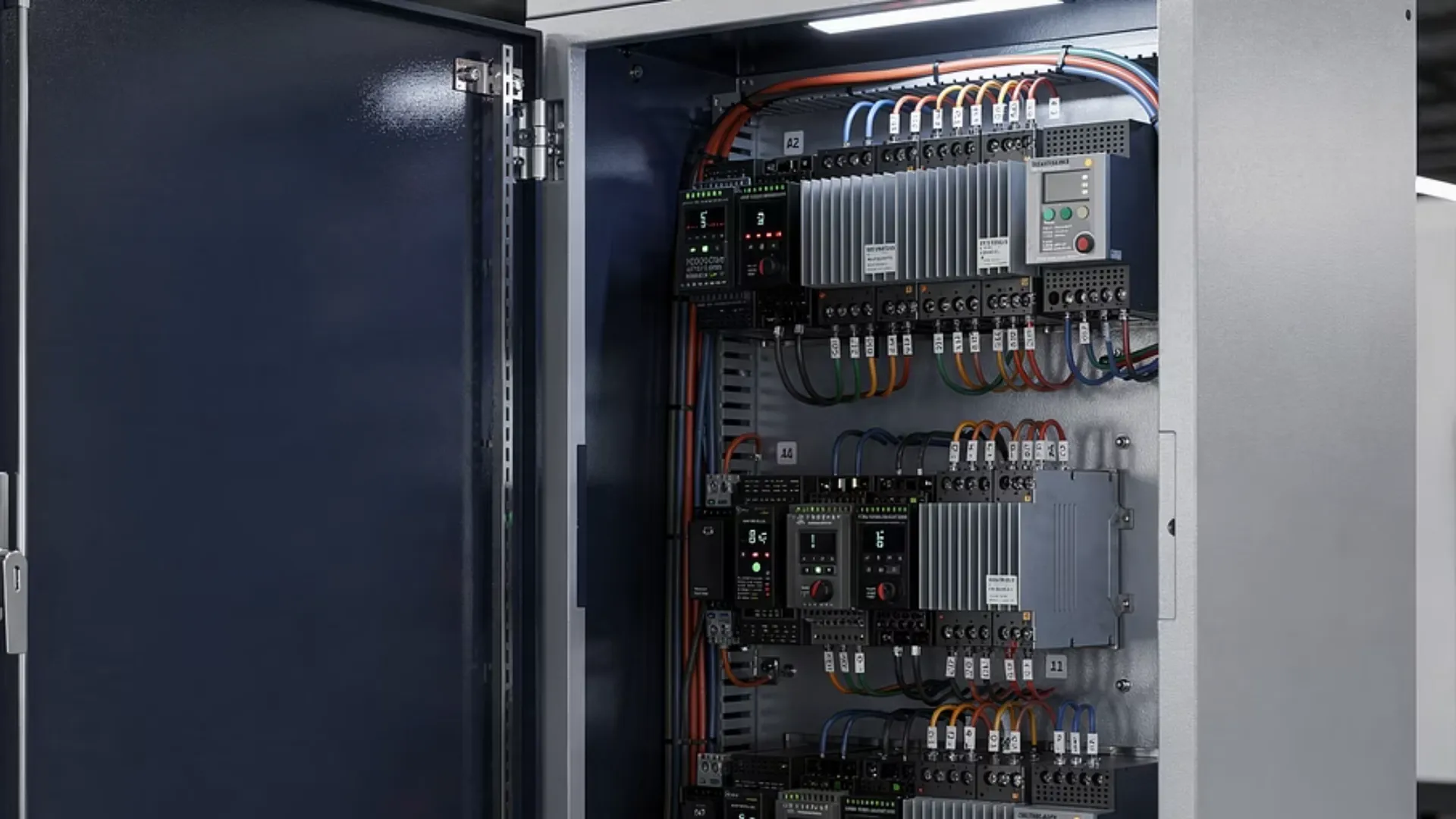
Industrial electrical switchgear — also referred to as a control panel or electrical enclosure — is a set of electrical and electronic devices mounted inside a metallic or polyester enclosure. Its function is to distribute electrical power, protect circuits and control the processes of a machine or production line.
Unlike a domestic consumer unit, industrial switchgear incorporates automation elements (PLC, variable-frequency drives, HMI) and must comply with specific machinery-safety standards. For guidance on enclosure selection and IP protection ratings, see our guide to industrial electrical enclosures.
Components of Industrial Electrical Switchgear
Components are organised into four functional groups:
Protection
- Miniature circuit breakers (MCBs): protect against overloads and short circuits. They are rated according to the nominal current of the circuit.
- Residual-current devices (RCDs): detect earth-leakage currents and protect against indirect contact.
- Fuses: supplementary protection for critical circuits.
- Surge protection devices: essential in areas prone to lightning or unstable supply networks.
Control and Switching
- Contactors: switch inductive loads (motors) via a control signal.
- Variable-frequency drives (VFDs): regulate the speed of asynchronous motors with energy savings.
- Soft starters: limit inrush current on high-power motors.
- Control relays: amplify control signals to activate contactors or other devices.
Automation
- PLC (programmable logic controller): executes the machine's control logic. MECVIL programmes Siemens, Omron, Panasonic and Mitsubishi at its electrical division.
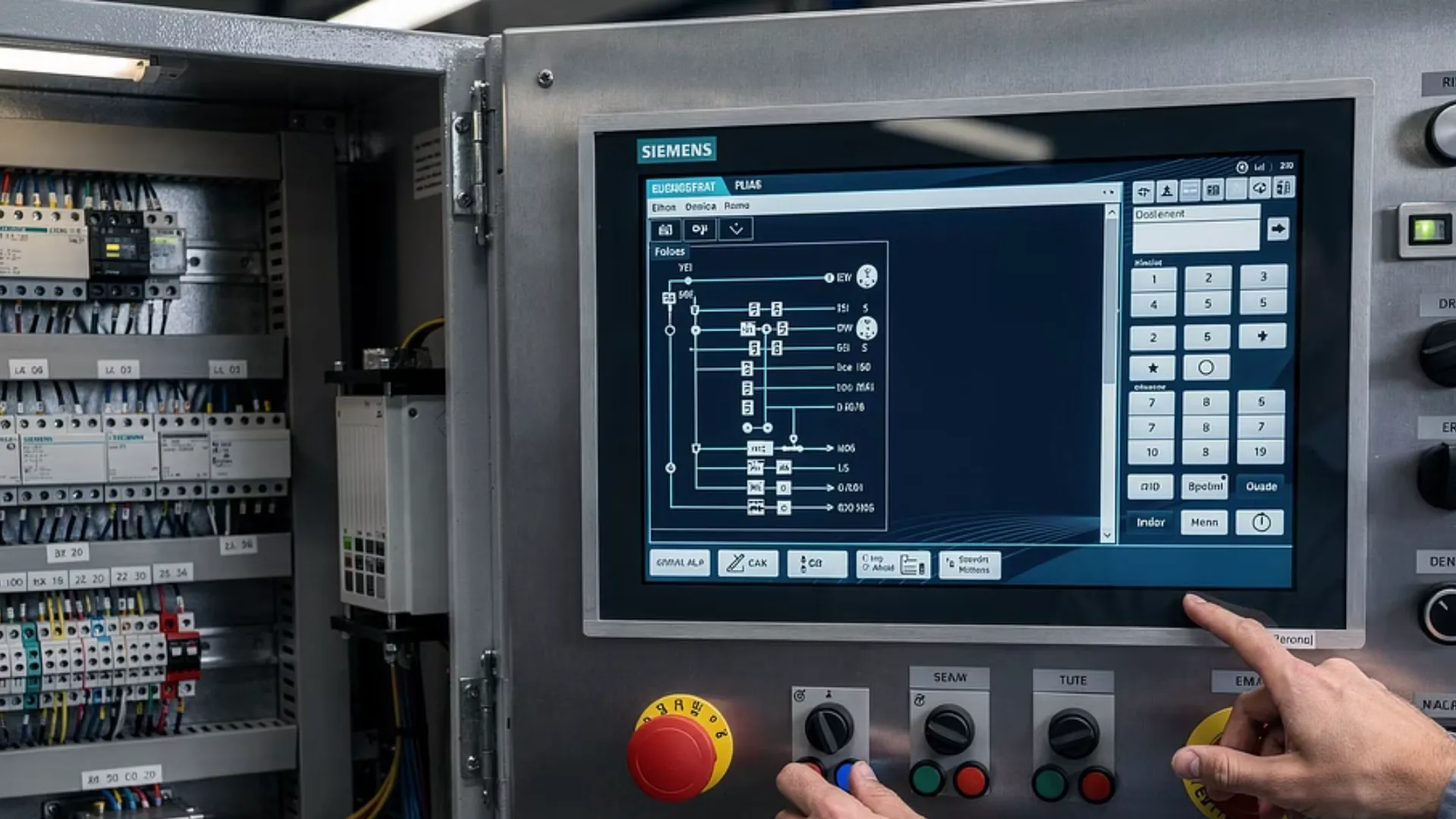
- HMI (human-machine interface): touchscreen that allows the operator to monitor and adjust parameters.
- Distributed I/O modules: peripherals connected via fieldbus (Profinet, EtherCAT) that reduce point-to-point wiring.
Distribution and Connection
- Busbars: distribute main power to the individual circuits.
- Terminal blocks: organised and labelled connection points following the electrical schematic.
- Power supplies: convert mains voltage (400 V AC) to control voltages (24 V DC).
- Cable trunking and DIN rails: organise wiring and secure components inside the enclosure.
| Functional group | Key components | Primary function |
|---|---|---|
| Protection | MCBs, RCDs, fuses | Circuit safety |
| Control | Contactors, VFDs, soft starters | Load switching |
| Automation | PLC, HMI, distributed I/O | Logic and supervision |
| Distribution | Busbars, terminals, 24 V PSUs | Power and connection |
Applicable Standards: IEC 61439, EN 60204-1 and REBT
The design of industrial electrical switchgear must comply with a regulatory framework that guarantees operator safety and installation reliability.
IEC 61439 — Low-Voltage Switchgear and Controlgear Assemblies
This standard supersedes the former IEC 60439 and introduces three design-verification methods: laboratory testing, calculation and compliance with design rules. It also mandates internal-arc resistance testing — a significant advance in protection against severe faults.
EN 60204-1 — Safety of Machinery — Electrical Equipment
This standard defines the requirements for the electrical equipment of machines and confers a presumption of conformity with the Machinery Directive 2006/42/EC. Key provisions include:
- The main isolator must be mounted at a height of 0.6 to 2.0 m above floor level and be operable without opening the enclosure door.
- Conductors must follow a standardised colour code (blue = neutral, green-yellow = earth).
- Safety circuits must be designed in accordance with EN ISO 13849 (performance level, PL) or EN 62061 (SIL).
REBT — Spanish Low-Voltage Electrotechnical Regulation
In Spain, the complementary technical instructions ITC-BT-16 (supply installations), ITC-BT-17 (protective devices) and ITC-BT-19 (cables) are mandatory for switchgear installation.
To learn more about industrial process automation and how the electrical switchgear integrates into the wider installation, see our dedicated article.
How to Specify Switchgear for Your Machine
Before commencing the design, define the following parameters with your engineering team:
- 1.Installed power: total power of all loads (motors, heaters, lighting).
- 2.Supply voltage: 400 V three-phase is standard in industry; verify neutral availability.
- 3.IP protection rating: minimum IP54 for dusty industrial environments; IP65–IP66 for washdown or food-processing areas.
- 4.Automation level: from basic contactor switching to full PLC, HMI and fieldbus control.
- 5.Safety requirements: emergency-stop category, performance level (PL) based on risk assessment.
- 6.Communications: required protocols (Profinet, EtherCAT, OPC-UA) for integration with other equipment or SCADA systems.
- 7.Environmental conditions: temperature, humidity, chemical agents, vibration.
At MECVIL, electrical design is part of our turnkey projects: from the electrical schematic in EPLAN through to enclosure manufacture, wiring, PLC programming and commissioning.
Need bespoke switchgear for your machine or production line?
Request a quotation and our electrical department will analyse your power, control and communications requirements.
Electrical Switchgear and Industry 4.0
Digitalisation is transforming the industrial electrical switchgear assembly into an intelligent node within the connected factory.
Integrated Connectivity
Modern switchgear incorporates industrial Ethernet switches and OPC-UA gateways that transmit production data, energy consumption and component status to MES or SCADA systems in real time. MECVIL integrates these communications in its industrial automation projects.
Predictive Maintenance
Temperature, current and vibration sensors installed inside the enclosure feed predictive-maintenance algorithms. Periodic thermography (recommended every 2–3 months per ISO 18434) detects hot spots indicating overloads, loose connections or insulation degradation.
Digital Twins
The 3D model of the switchgear — generated during the EPLAN design phase — becomes a digital twin that enables modification simulation, remote fault diagnosis and operator training without halting production.
These technologies turn the electrical switchgear into a manageable asset, not merely a component enclosure.
---
MECVIL designs and manufactures bespoke industrial electrical switchgear at its electrical and electronic division, with the capability to programme PLC Siemens, Omron, Panasonic and Mitsubishi, integrate machine-vision systems and coordinate complete robotised lines. 50 years of experience, ISO 9001 certification and 10,500 m² of facilities in Barcelona underpin every project.
[Request a quotation for your switchgear →](/en/contacto)