Industrial welding: types, standards and machinery applications
What is industrial welding and why is it critical in machinery?
Industrial welding is the process of joining metals through the controlled application of heat, pressure or both, fusing the base materials to create a permanent bond. In special-purpose machinery manufacturing, welding is not a secondary operation: it is a critical process that determines the structural strength, durability and safety of the machine.
Poor welding on a press frame, a gantry structure or a pressure vessel can compromise the integrity of the entire machine. This is why structural metalwork manufacturers must demonstrate competence through qualified welding procedures, certified welders and recognised quality systems such as the ISO 3834 standard and the ISO 9001 management system.
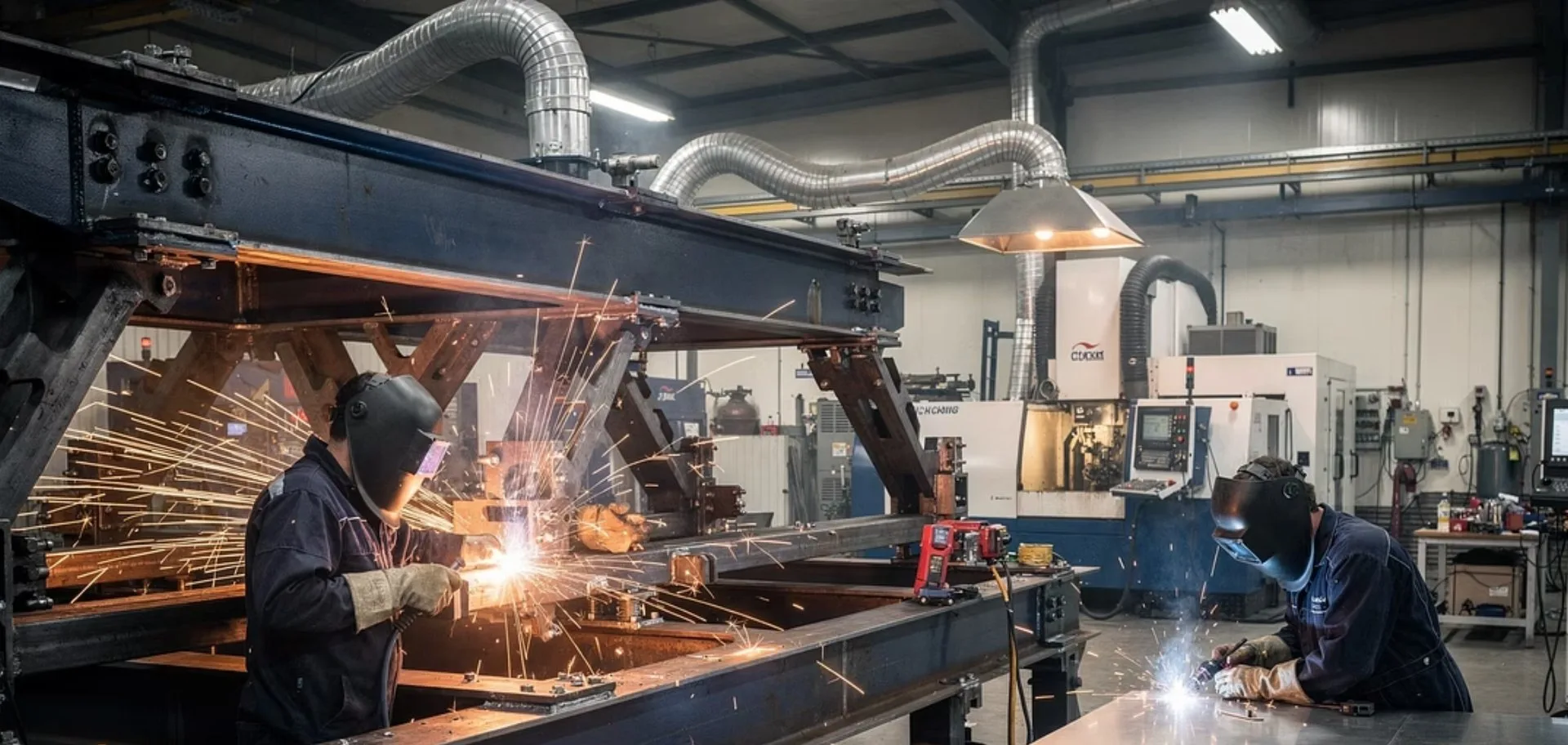
At MECVIL, we have a 600 m² welding workshop in Sallent, dedicated exclusively to welding and boilermaking operations. Our ISO 9001 quality system and qualified welding procedures (WPS/WPQR) accredit our competence in the execution of steel and aluminium structures, and form an integral part of our integrated manufacturing service.
Main types of industrial welding
The choice of welding process depends on the material, thickness, position, quality requirements and production volume:
MIG/MAG (GMAW)
The most widely used process in industrial manufacturing. It uses a continuously fed wire electrode and shielding gas. MIG (inert gas: argon) is used for aluminium and stainless steel. MAG (active gas: CO₂ or mixture) is the standard for carbon steel. Its high deposition rate makes it the preferred process for production and for robotic welding.
TIG (GTAW)
Offers the highest quality and precision of all arc processes. It uses a non-consumable tungsten electrode and inert gas (argon or helium). Ideal for stainless steel, aluminium and thin sections where aesthetic finish and the absence of spatter are requirements. It is slower than MIG/MAG, but indispensable in sectors such as food, pharmaceuticals and aerospace.
Shielded metal arc welding (SMAW)
The most versatile manual process. It requires no external shielding gas or complex equipment. It works in all positions and outdoors. It is the benchmark for maintenance, repair and field work, although its productivity is lower than semi-automatic processes.
Submerged arc welding (SAW)
The arc is produced beneath a layer of granular flux, eliminating spatter and fumes. It offers deposition rates of several kilogrammes per hour on thick sections. It is used for heavy structures: bridge beams, vessels, wind towers and large frames.
Need to fabricate welded structures with certified quality control?
At MECVIL, we have 600 m² of welding workshop, an ISO 9001 quality system and qualified welding procedures. Request a quote.
Robotic welding: when to automate
Welding automation using robots offers significant advantages over manual welding:
- Productivity: a robot welds continuously, achieving productivity 5 to 6 times greater than a manual welder
- Consistency: every bead is identical to the previous one, with electronically controlled parameters
- Quality: defects (porosity, lack of fusion, undercut) are reduced by eliminating human variability
- Safety: the operator is not exposed to the arc, fumes or UV radiation
- Return on investment: the typical payback period is less than 18 months in medium-to-high production applications
At MECVIL, we manufacture robotic welding stations with integrated robot and welding equipment, as well as cells with two robots for simultaneous operations. Tooling carriages allow the cell to be fed while the robot welds, maximising active arc time.
Robotic welding is ideal when there is sufficient volume to justify the programming and tooling. For short runs or one-off parts, manual welding with qualified welders remains the most efficient option.
Welding quality standards: ISO 3834 and ISO 9001
Requirement levels according to the application
Not all welded structures demand the same level of control. The criticality of the application determines the severity of the requirements for inspection, traceability and personnel qualification:
| Application | Requirement level | Typical examples |
|---|---|---|
| Light structures | Low | Railings, staircases, auxiliary supports |
| Standard structures | Standard | Industrial buildings, machinery frames |
| Structures subject to fatigue | High | Bridges, cranes, cyclically loaded components |
| Critical structures | Maximum | Nuclear structures, offshore platforms |
The more critical the application, the more stringent the requirements for inspection, traceability and personnel qualification. At MECVIL, we apply the appropriate level of control to each project, which allows us to fabricate welded structures for the demands of industrial machinery manufacturing: frames, machine beds, gantries and support structures.
ISO 3834: quality in fusion welding
The ISO 3834 standard sets out the quality requirements for fusion welding processes, defining three levels: comprehensive (CL1), standard (CL2) and elementary (CL3). The requirements include:
- Qualified welders and welding coordinators
- Documented welding procedures (WPS/WPQR)
- Calibrated and maintained equipment
- Inspection through non-destructive testing (END/NDT)
The combination of the ISO 3834 standard with our ISO 9001 quality system ensures that every welded structure at MECVIL meets the applicable quality requirements.
Welding in special machinery projects
In a turnkey project for industrial machinery, welding is integrated into the production workflow as one more phase:
- 1.[Engineering](/en/servicios/ingenieria) defines the structure geometry, materials and welding specifications
- 2.Cutting and preparation of sheet metal and sections according to drawings
- 3.Welding in our 600 m² workshop using the processes appropriate to the material and regulatory requirements
- 4.[CNC machining](/en/servicios/mecanizado) afterwards for functional surfaces requiring dimensional precision (bearing housings, guideways, datum faces)
- 5.[Electromechanical assembly](/en/servicios/montaje) of the complete unit
- 6.[CE](/en/noticias/directiva-maquinas-marcado-ce) conformity of the assembly, including welding documentation
This sequence — welding → machining → assembly — is carried out entirely at our 10,500 m² facilities, without subcontracting intermediate phases. It is one of the key advantages of working with an integrated manufacturer that controls all disciplines under one roof.
Looking for a manufacturer with integrated welding, machining and assembly capabilities?
At MECVIL, we fabricate welded structures with ISO 9001 quality control, machine them with CNC up to 20 metres and assemble them into complete machines. Contact our technical team.