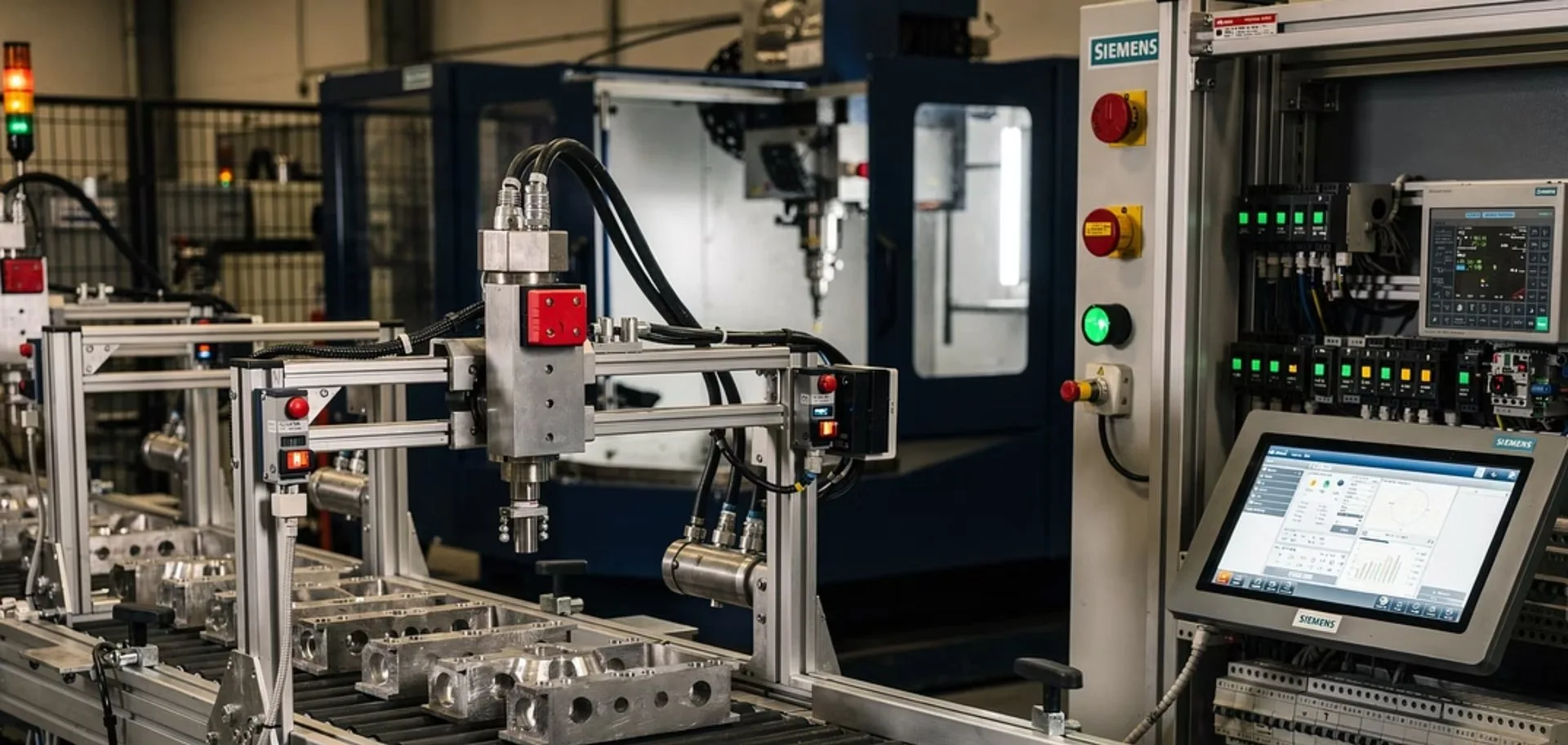
Industrial process automation: from sensor to complete production line
What does it mean to automate an industrial process?
Automating an industrial process means replacing manual operations with controlled systems that perform the same tasks with greater speed, precision and repeatability. But industrial automation is not about placing a robot where an operator used to be. It is about redesigning the process so that it runs autonomously, safely and with full traceability.
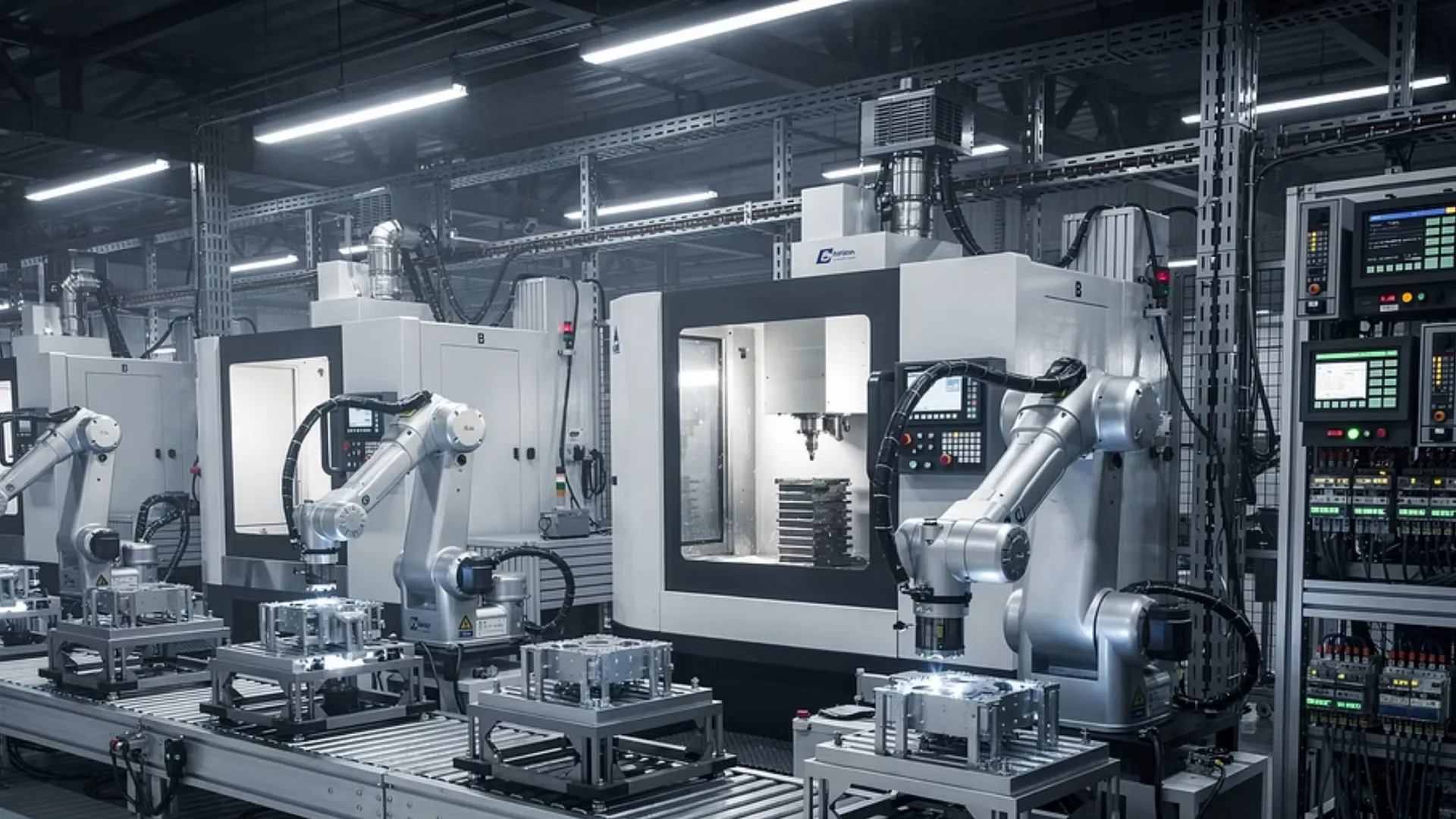
Industrial process automation ranges from fitting sensors to an existing machine through to the complete design of an automated production line with multiple stations, robots, machine vision and communication with the plant management system.
At MECVIL, we automate industrial processes as machinery manufacturers: we design the machine, build it, wire it, programme it and commission it. Our electrical engineering department has delivered more than 18 automation projects involving PLC, robots, machine vision and FMS lines.
The 4 levels of process automation
The automation of an industrial process is structured in hierarchical levels, following the automation pyramid model (ISA-95):
Level 0: Field (sensors and actuators)
The base level connects the machine to the physical world. Sensors capture variables (position, pressure, temperature, presence, force) and actuators carry out the actions (pneumatic cylinders, motors, valves, servomotors). Without sound field-level design, the rest of the system cannot function.
Level 1: Control (PLC)
The PLC receives signals from the sensors, executes the control logic and sends commands to the actuators. At MECVIL we programme PLCs from Siemens, Omron, Panasonic and Mitsubishi, selecting the brand according to the client's preferences and the process requirements.
Level 2: Supervision (HMI/SCADA)
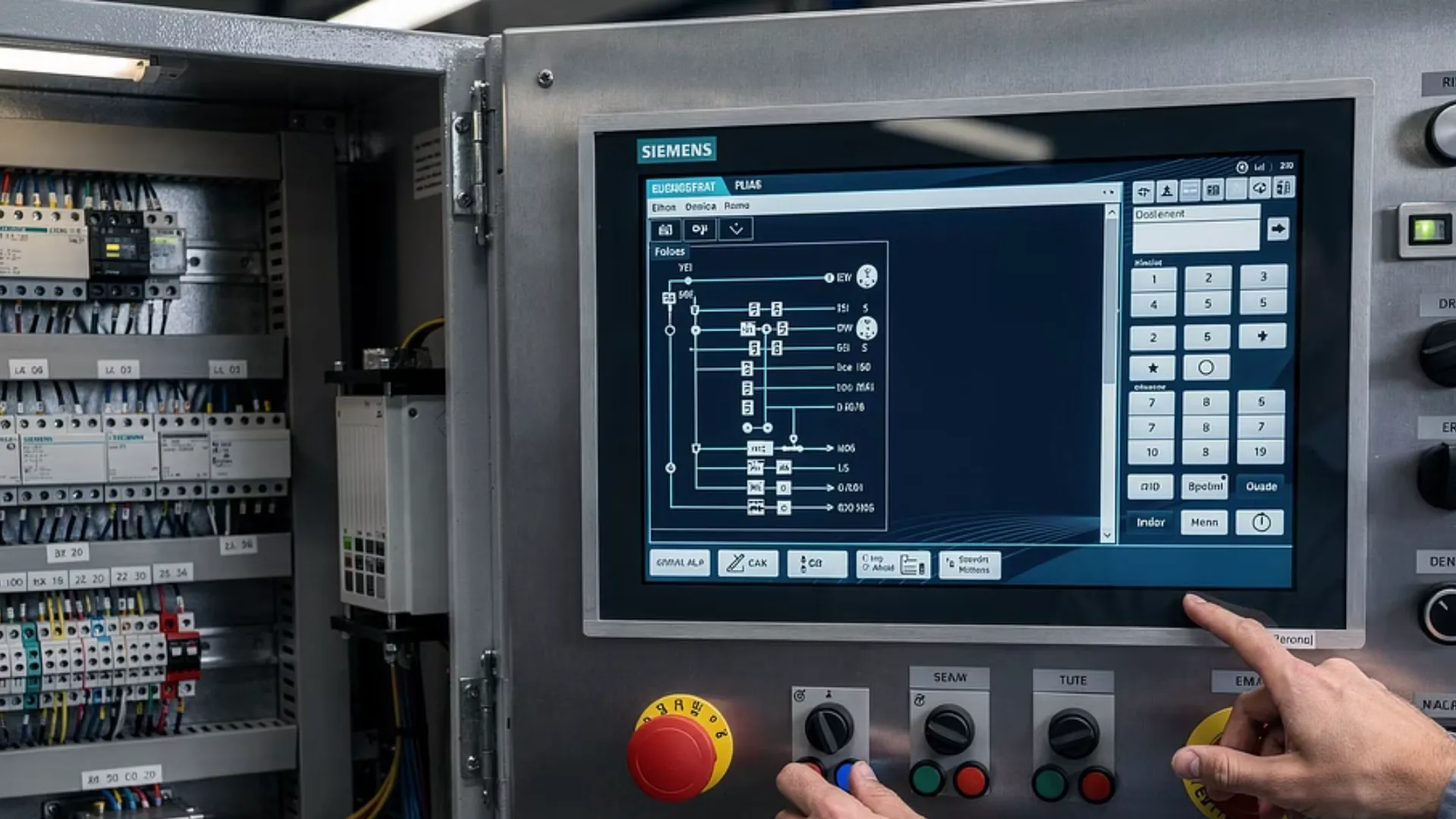
HMI panels allow the operator to monitor the process, adjust parameters and manage alarms. SCADA systems supervise multiple machines or stations from a central workstation. We work with HMI panels from Siemens, Omron and Proface.
Level 3–4: Management (MES/ERP)
The upper levels connect production with business management. The MES monitors production in real time (OEE, traceability, batches) and the ERP consolidates planning, costs and logistics.
Looking to automate a process in your production plant?
At MECVIL we design and manufacture turnkey automated machinery. Talk to our team.
How is a process automated step by step?
Industrial process automation follows a sequence that at MECVIL we carry out as part of our integral 360° service:
- 1.Current process analysis: observation of the manual process, identification of bottlenecks, measurement of cycle times and defect rates
- 2.Scope definition: which operations are automated and which remain manual. Not everything should be automated; the criterion is return on investment
- 3.[Conceptual engineering](/en/servicios/ingenieria): 3D CAD design of the automated system, cycle simulation, component selection (sensors, actuators, PLC, robots)
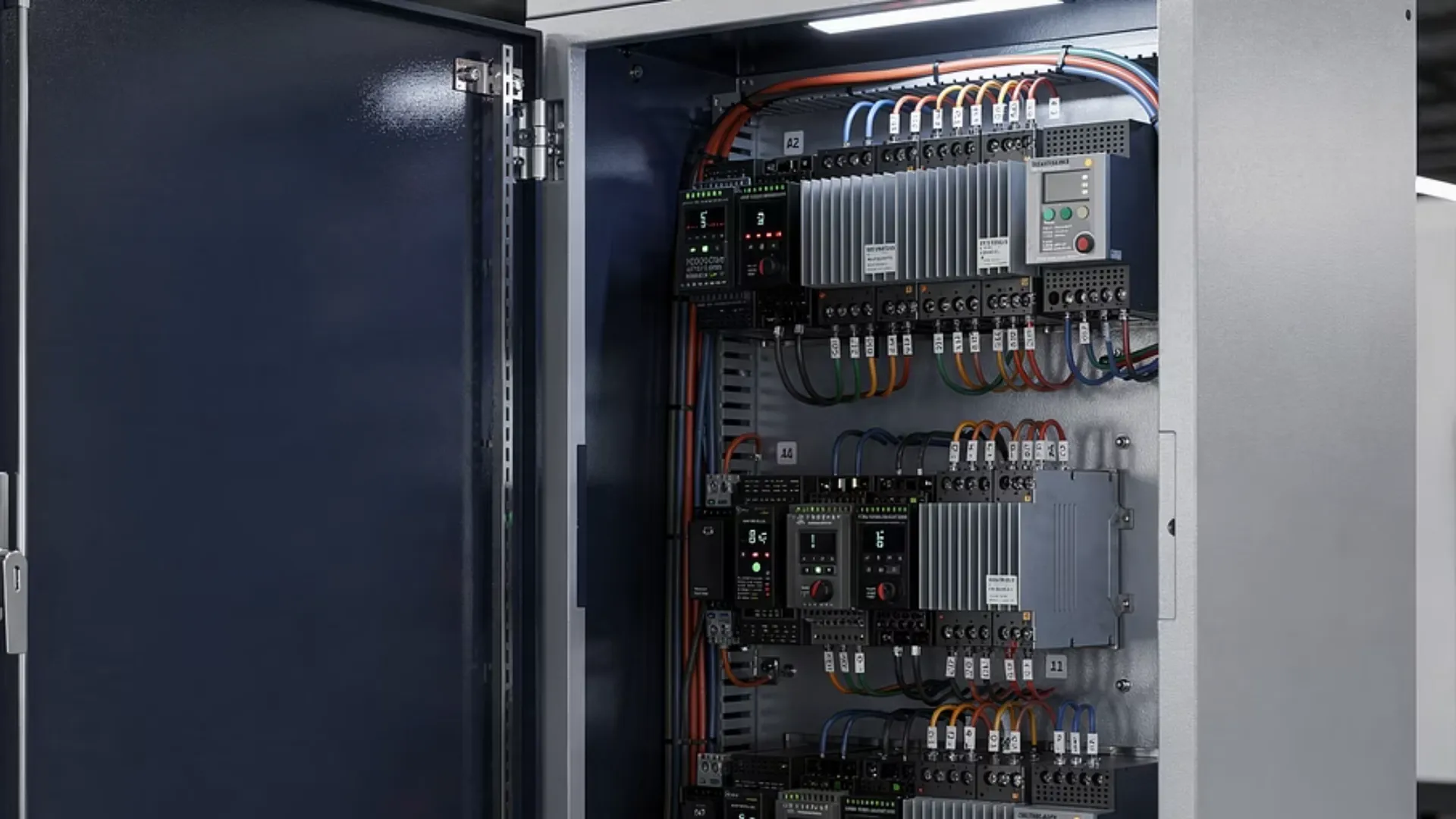
- 4.Detailed engineering: electrical schematics in EPLAN, protection selection, drive sizing, electrical panel design
- 5.Mechanical manufacturing: CNC machining of baseplates, tooling and structures in our own facilities
- 6.[Electromechanical assembly](/en/servicios/montaje): mechanical, electrical, pneumatic and hydraulic integration
- 7.Programming and commissioning: PLC, HMI, robots, machine vision, functional testing (FAT at the factory, SAT at the client's plant)
At MECVIL, all 7 phases are carried out in our 10,500 m² facilities by a team of +110 professionals. This eliminates the coordination issues between suppliers that typically delay fragmented automation projects.
Key technologies in process automation
Industrial sensors
- Inductive/capacitive: non-contact presence detection
- Photoelectric: through-beam, retro-reflective or diffuse detection
- Encoders: angular position and shaft speed
- Strain gauges: force and torque measurement in servo presses
- Code readers: QR, barcode and DataMatrix for traceability
Actuators
- Servomotors: position, speed and torque control with micrometric precision. At MECVIL we integrate servomotors with regenerative braking energy recovery
- Pneumatic cylinders: fast actuation for clamping, insertion and ejection operations
- Variable frequency drives: speed control for asynchronous motors
Machine vision
Machine vision systems enable 100 % production inspection: component presence verification, dimensional checking, code reading and defect detection. At MECVIL we have integrated 2D cameras, 3D profilometers and AOI systems across multiple projects.
When is automation worthwhile?
Industrial process automation is cost-effective when the following conditions are met:
- Repetitive operations: the same sequence is repeated part after part, shift after shift
- Significant defect rate: manual variability generates rejects or rework that automation eliminates
- Medium-to-high volume: sufficient production to pay back the investment (typically 6 to 24 months depending on complexity)
- Traceability requirements: sector regulations demand part-by-part recording of process parameters
- Ergonomics or safety: awkward postures, heavy load handling or exposure to hazards that justify robotisation
Industry data indicate an error reduction of 70–95 % and a productivity increase of 25–30 % in automated processes compared with manual ones. For SMEs, funding programmes such as Kit Digital and PERTE grants are available for industrial digitalisation projects.
Real automation cases at MECVIL
Our experience includes process automation projects in a wide range of configurations:
- FMS lines with 5 robots: automotive electronic component assembly with machine vision, automatic screwdriving and depalletising. Three lines delivered (V787, MT9, electronics)
- Servo-press stations: assembly monitoring with 2D inspection camera and 3D profilometer, measuring force and position on every insertion
- 12-station semi-automatic line: with in-line final verification for electronic assembly
- Integrated poka-yoke systems: presence sensors and correct-insertion verification that prevent defective parts from advancing
Each of these projects demonstrates that industrial process automation is not a theoretical concept: it is real machinery that we design, manufacture and commission, applying lean manufacturing principles so that every automation delivers measurable value from day one.
Looking for a manufacturer to automate your process from start to finish?
At MECVIL we cover everything from engineering to commissioning, including CNC machining, assembly and PLC programming. Get in touch with our technical team.