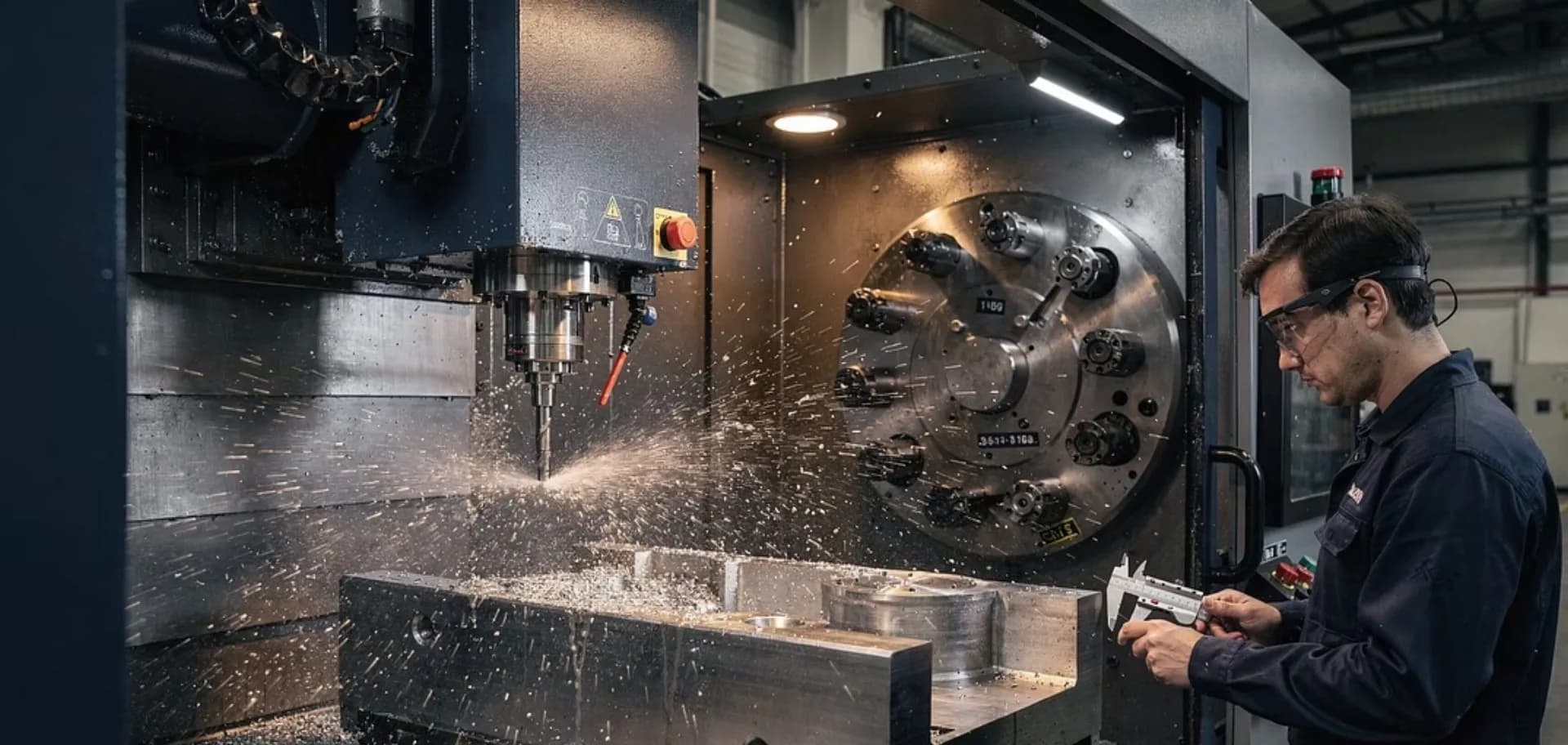
Machining Technology and Contract CNC Machining: A Practical Guide
What is machining technology?
Machining technology encompasses all manufacturing processes in which material is removed from a workpiece by mechanical cutting to achieve the desired geometry. Unlike forming or additive processes, the workpiece reaches its final shape through chip-removing operations — milling, turning, drilling, grinding.
In modern industry, CNC machining is the standard method for producing precision components from metal and plastic. CNC-controlled machines execute the programmed machining steps with a repeatability of ±0.002 mm — hour after hour, shift after shift.
At MECVIL, we have been performing CNC machining for over 50 years at our facilities in Sallent (Barcelona). With a capacity of 5,000 machine-hours per month, CNC milling machines with up to 20 metres of travel and simultaneous 5-axis machining, we offer contract CNC machining for demanding industrial clients across Europe.
Machining technology processes
CNC milling
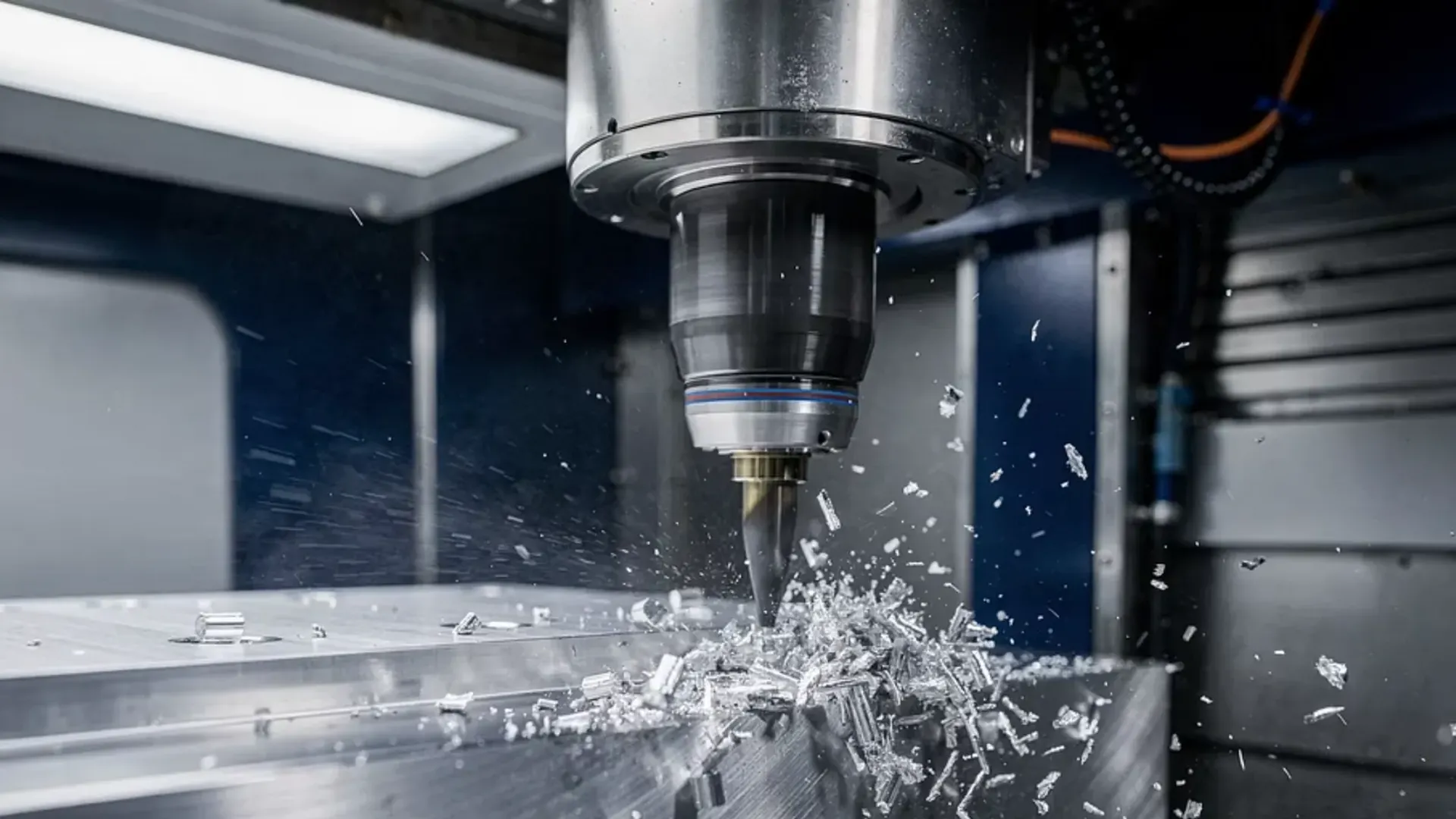
The most versatile machining process: a rotating multi-edge tool machines the stationary workpiece. Machining centres with automatic tool changers enable complete machining in a single set-up — face milling, profile milling, pocketing, drilling and tapping without re-clamping.
At MECVIL, we mill on bed-type milling machines with up to 20 m of travel and on 5-axis centres for complex geometries.
CNC turning
The workpiece rotates whilst a single-point tool removes material. Ideal for rotationally symmetrical parts: shafts, bushings, flanges, threaded components. More about CNC turning.
Grinding
For the tightest tolerances and highest surface qualities (Ra < 0.8 µm). Cylindrical, surface and profile grinding complement milling and turning when the required dimensional accuracy exceeds what is achievable with cutting tools.
Wire EDM
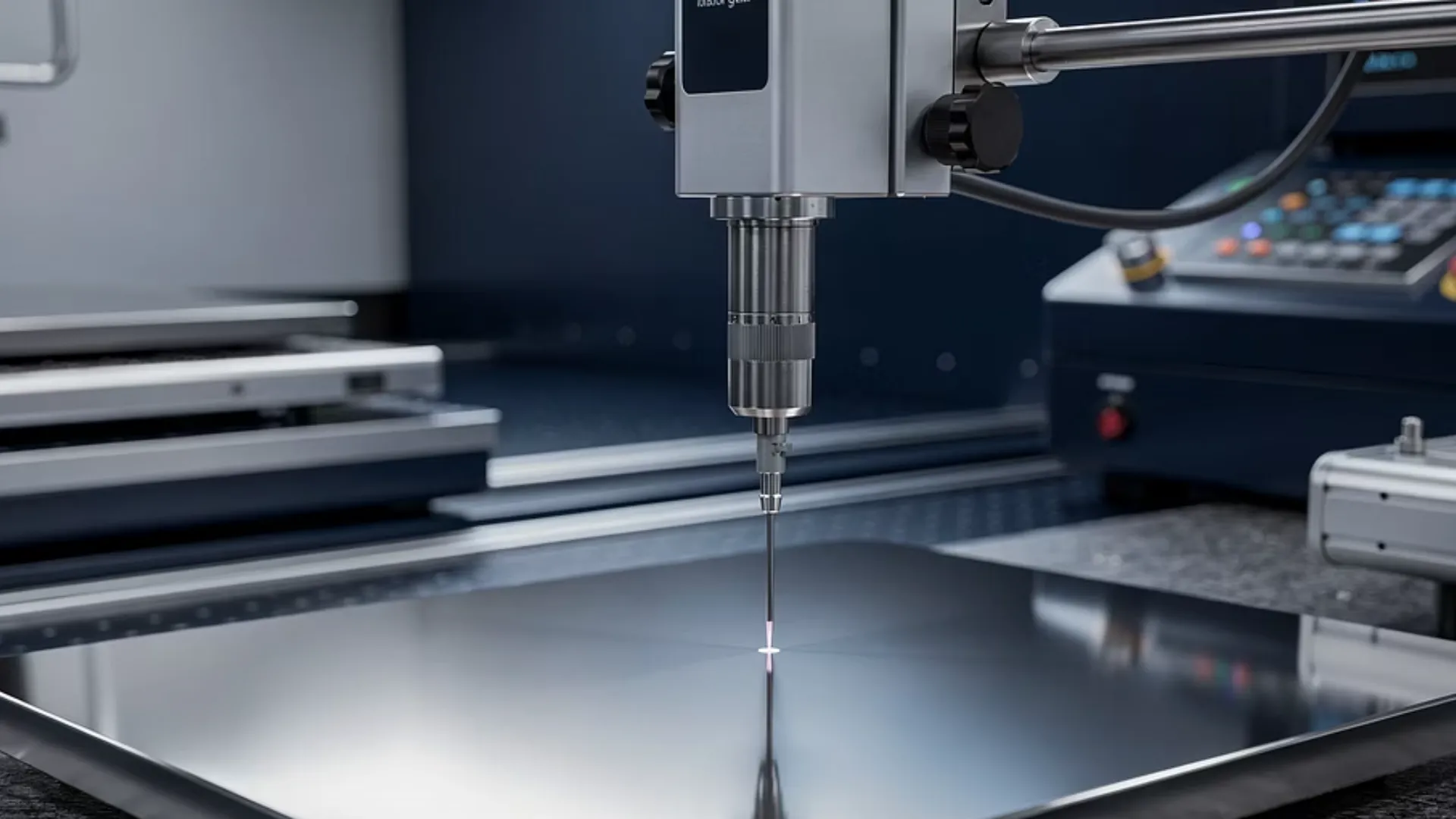
Wire EDM (wire electrical discharge machining) is not a classical machining process, but is frequently used in combination with mechanical machining — particularly for hardened tools, dies and fixtures with ±0.005 mm tolerance.
Looking for a contract CNC machining partner with a comprehensive machine park?
Contact our team — we machine your parts from prototype to series production.
Materials in machining technology
The choice of cutting parameters depends directly on the material:
- [Aluminium](/en/servicios/mecanizado/mecanizado-aluminio) (6061-T6, 7075): Excellent machinability, high cutting speeds possible. Primary material in the railway and aerospace industries.
- Structural steel (S235, S355, C45): Economical and easy to machine. Standard for machine frames and fixtures.
- Quenched and tempered steel (42CrMo4, 34CrNiMo6): For highly loaded shafts, gears and structural components.
- Stainless steel (1.4301, 1.4404): Corrosion-resistant, but prone to work hardening. Requires lower speeds and ample cooling.
- Titanium (Ti-6Al-4V): Excellent strength-to-weight ratio, but difficult to machine. Specialist tooling and low speeds required.
- Cast iron (GJL, GJS): Rigid and vibration-damping. Abrasive swarf demands wear-resistant tooling.
- Engineering plastics (POM, PEEK, PA): Low cutting forces, but sensitive to heat generation.
Tolerances and surface quality
| Machining process | Tolerance | Ra (surface roughness) |
|---|---|---|
| CNC milling (standard) | ±0.025 mm | 1.6 – 3.2 µm |
| CNC turning (standard) | ±0.025 mm | 1.6 – 3.2 µm |
| CNC milling/turning (precision) | ±0.005 mm | 0.8 – 1.6 µm |
| Grinding | ±0.005 mm | 0.1 – 0.8 µm |
| Wire EDM | ±0.005 mm | 0.2 – 1.6 µm |
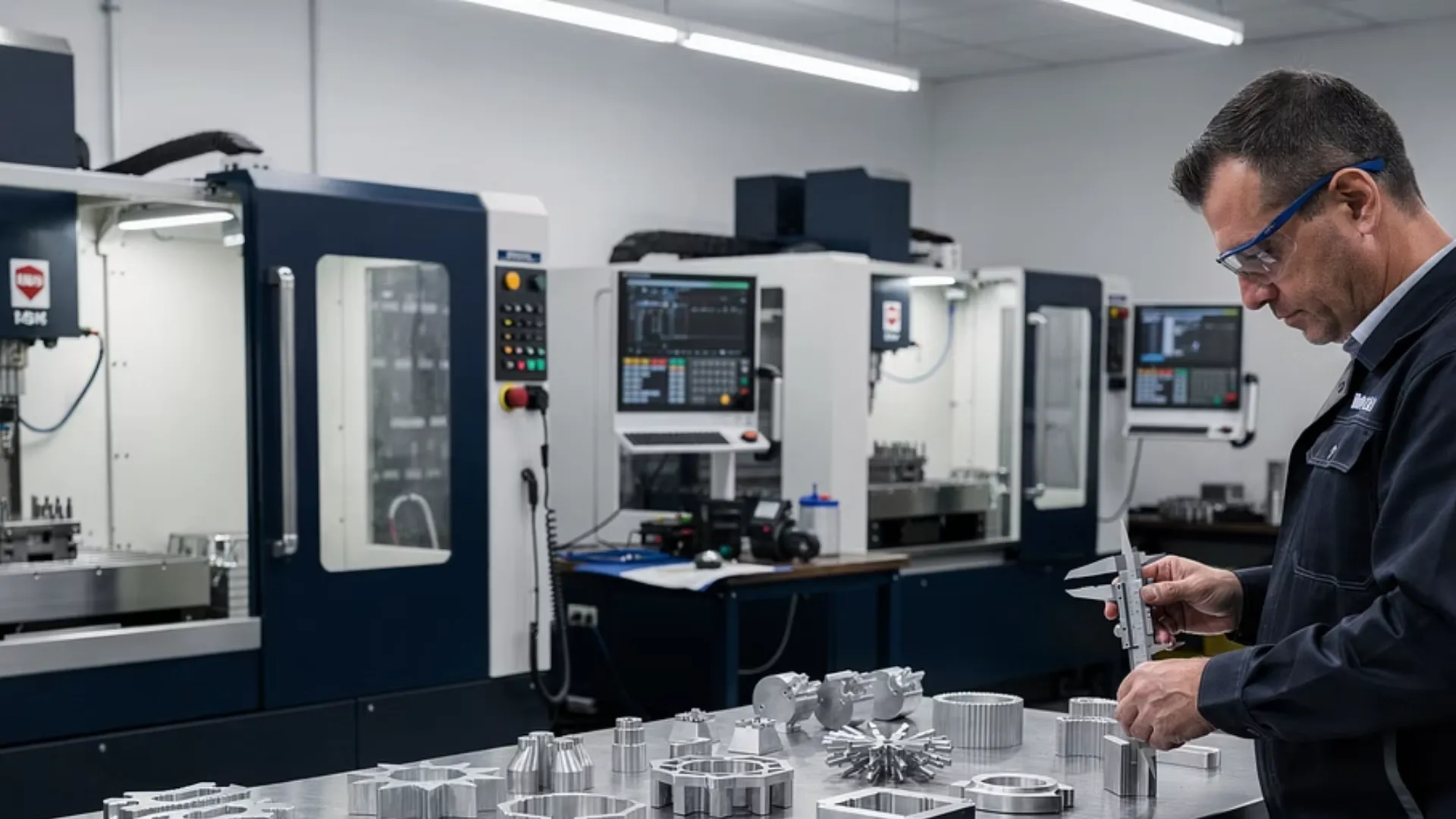
The most common tolerance specification on industrial drawings is ISO 2768-mK. For fits, tolerance classes according to ISO 286 (shaft/hole) apply. At MECVIL, we verify all toleranced dimensions with 3D coordinate metrology and deliver documented measurement reports under our ISO 9001 quality management system.
Contract CNC machining: when to outsource?
Outsourcing machining to a specialist contract manufacturer makes sense when:
- No in-house machine park is available or capacity is insufficient
- Specialist machines are required (5-axis, large-part machining up to 20 m) that do not justify the capital investment
- Flexible capacity is needed for demand peaks without increasing fixed costs
- Certified quality is demanded (ISO 9001 and quality-controlled welding for steel structures)
- Integration of additional services is desired: engineering, welding, assembly, PLC programming
For DACH companies, MECVIL as a Spanish contract CNC machining partner offers an additional advantage: 30–40% lower manufacturing costs with equivalent machine quality and an ISO 9001 quality management system. Add to that 50 years of experience, vertical integration under one roof and the same PLC brands (Siemens/Omron/Mitsubishi) your usual suppliers already work with.
Why MECVIL as your machining partner?
MECVIL combines machining technology with five further disciplines under one roof — making us far more than a simple contract CNC machining provider:
| Discipline | Service |
|---|---|
| Engineering | 3D CAD, FEA simulation, validation with virtual reality |
| CNC machining | Milling (up to 20 m), turning, grinding, 5-axis |
| Welding | 600 m² welding workshop, certified welding for metal structures, robotic welding |
| Assembly | Mechanical, electrical, pneumatic, hydraulic |
| Electrical engineering | Control panels, PLC Siemens/Omron/Mitsubishi, robotics |
| Turnkey service | End-to-end project management from engineering to commissioning |
This vertical integration means that if your project goes beyond pure machining — for example, welded assemblies with subsequent CNC machining and electromechanical assembly — we can deliver everything from a single source. No coordination effort between five subcontractors.
We apply Lean Manufacturing principles in our production to minimise set-up times, maximise machine utilisation and reduce cost per part — even for one-off parts and small batches.
Looking for an integrated machining partner in Europe?
MECVIL offers CNC machining up to 20 m, welding, assembly and PLC programming under one roof — with 50 years of experience and certified quality. Contact us for a no-obligation quotation.